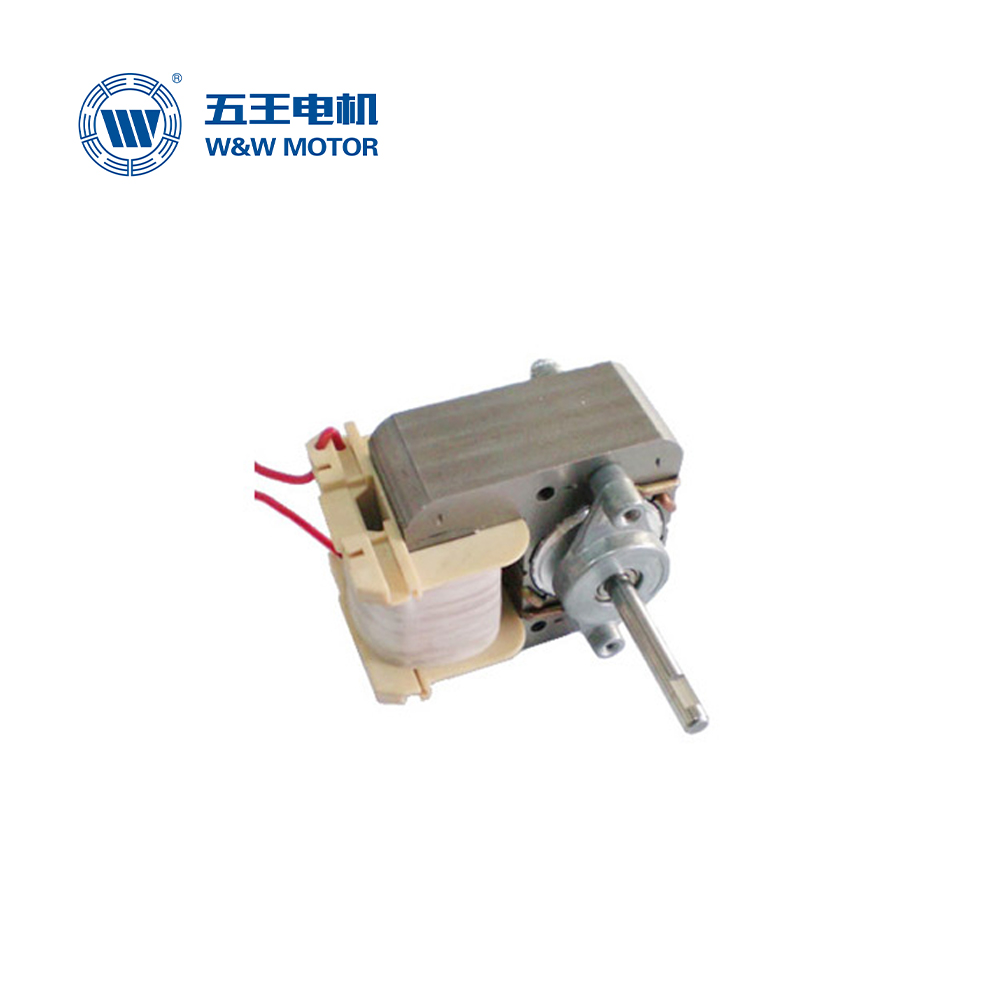
Shaded Pole Motor for Commercial Convection Ovens: Matching Airflow to Cavity Heat (2026)
Published: November 3, 2026 | By W&W Motor Engineering Team
Short answer: a 61-frame shaded pole motor between 20 W and 45 W, wound for Class F or Class H insulation and rated against a 60–90°C compartment ambient rather than the oven's 250°C setpoint, is what most commercial convection ovens actually need. Getting that one number wrong is the most common reason oven fan motors seize inside twelve months. This guide gives the airflow, stack-height and certification data needed to specify a shaded pole motor for commercial convection oven fan assemblies without over- or under-buying.
1. What Size Motor Does a Convection Oven Fan Need at 250°C?
The motor never sits at 250°C. In a normal convection oven the fan motor lives behind a baffle in a compartment that stabilises at 60–90°C while the cavity runs at 220–260°C. Winding temperature equals that compartment ambient plus the motor's own temperature rise, typically 30–45 K at rated load. Specify against the setpoint and you buy a motor that looks thermally generous on paper and runs under-designed in the field.
So when engineers ask what size motor for a convection oven fan 250 degrees actually calls for, the honest method is three measurements, not one datasheet lookup.
• Log the compartment ambient after 90 minutes at full heat with the fan running — never with the oven cold.
• Match impeller diameter to the airflow the cavity needs. A 150 mm impeller at 2,500 rpm moves roughly 90–120 m³/h against 40–60 Pa; a 200 mm impeller at the same speed moves 160–200 m³/h against 70–100 Pa.
• Choose stack height for torque, not for wattage. On a 61-frame motor, going from a 20 mm to a 30 mm stack adds roughly 40–50% locked-rotor torque — and adds current and heat with it.
Duty cycle is the second half of sizing. A commercial oven runs S1 continuous for 45–90 minute bake cycles, often twelve hours a day — a different duty class from a range hood fan cycling for minutes at a time, and why a motor that survives in a hood can still fail on an oven line.
Airflow decides more than cooking speed. Uneven output creates hot spots near the discharge vent and cold corners at the back of the cavity — inconsistent browning in a dry oven, uneven condensation in a steam-assisted one. Both get blamed on the heating element when the real cause is a fan running 15% below design speed.
Reference points across the 61 series: the W&W Motor range starts with 6110 at 6 W and 2,600 rpm for small single-deck ovens; 6113 covers 10 W for compact oven and exhaust fan packs; 6116 at 16 W suits standard six-tray convection ovens; 6126 at 26 W handles larger cavities and dual-fan packs; 6130 reaches 45 W at 3,000 rpm for high-airflow and rotisserie loads. All are built from 110 V to 240 V at 50/60 Hz, with 5–10 mm shaft diameters and 15–45 mm stack heights. Full model data sits on the 61 series shaded pole motor page.
One trap: a 50 Hz motor at 2,400–2,800 rpm becomes 2,880–3,400 rpm on 60 Hz. Airflow rises about 20%, and so do windage noise and bearing load — re-check impeller tip speed before approving a dual-market build.
Working backwards from the setpoint is the shortcut most buyers take, and it is exactly what produces undersized fans and eight-month field failures. The only defensible way to answer what size motor for a convection oven fan 250 degrees actually requires runs through the compartment ambient, the impeller curve and the stack height.
✅ Bottom line: Size the motor from compartment ambient and impeller load, not from the cavity setpoint. A 20–26 W 61-frame unit covers most six-tray convection ovens.
2. What Certifications Does an Oven Fan Motor Need for UL, CE and Other Markets?
Two documents carry most of the weight: a UL Recognized Component file for North America and an EN 60335-1 test report behind the CE mark for Europe. Everything else is a subset, a regional addition, or a customer preference.
When procurement teams ask what certifications does an oven fan motor need ul ce, the practical answer breaks down by destination market.
• North America — UL Recognized Component (the RU mark) for the motor itself, plus cUL if Canada is in scope. "UL compliant" is not a category; ask for the file number printed on the label.
• Europe — a CE self-declaration is only defensible when it is backed by an EN 60335-1 report from a recognised laboratory, plus RoHS and REACH statements for the whole bill of materials.
• Retail and contract manufacturing — TUV or ITS marks shorten customer audits considerably, and appliance makers at the Hoshizaki or Panasonic tier routinely require one of them.
• China domestic — CCC where the finished appliance category requires it.
Teams that settle what certifications does an oven fan motor need ul ce before tooling rarely get a re-test surprise at pre-production approval.
Certification is also where insulation class stops being a datasheet line and becomes part of the safety case. Class B (130°C) is fine for a refrigerator. For an oven, start at Class F (155°C) and move to Class H (180°C) whenever the winding sits within about 100 mm of a heating element. Pair that with dual ball bearings on high-temperature grease — sleeve bearings dry out in that thermal zone and start to whine around month six. Add a thermal protector or fuse in the winding circuit, because blocked-rotor protection is the first thing a safety reviewer will ask about.
Timing matters as much as the documents. Reusing an existing certification file usually saves six to ten weeks against a fresh submission, which is often the difference between hitting a retail launch window and missing it. Changzhou W&W Motor Co., Ltd. has held ISO 9001 since 1997 and carries UL, CUL, CE, TUV, ITS and RoHS approvals across the 61 series, so an oven programme can normally be quoted against a file that already exists.
W&W Motor supplies these motors to GE, Panasonic, Hoshizaki, SKF and Beijing Yadu programmes — practical proof that the certification stack survives customer audits, not just a lab bench.
✅ Bottom line: For an oven fan, UL or cUL Recognized plus a CE report on EN 60335-1 is the minimum pair; Class F or H insulation belongs to the safety case.
FAQ
Q: Can a standard shaded pole motor survive in a convection oven?
A: Only if it is specified for the compartment ambient. A general-purpose shaded pole motor with Class B insulation and a sleeve bearing will run perfectly for weeks, then seize. The failure is thermal, not electrical — the grease leaves the bearing long before the winding complains. A shaded pole motor for commercial convection oven fan duty is specified as a system of insulation, bearing, protector and bracket, not picked off a catalogue page.
Q: Why do oven fan motors fail after 8–12 months when the rating looks correct?
A: Grease life sets the clock, not winding life. Every 10°C above the bearing's rated temperature roughly halves grease life, so a motor running 15°C too hot fails at month eight instead of year four. Audit three things: the real compartment ambient, whether a thermal protector is fitted, and whether the mounting bracket distorts at temperature and preloads the bearing.
Q: Does W&W Motor supply custom OEM oven fan motors?
A: Yes. W&W Motor builds OEM and ODM oven fan motors with shaft length and diameter to drawing, bracket geometry, lead length and connector, voltage and frequency, and insulation class. Typical wholesale MOQ is 1,000 units, with samples in about 7 days and bulk production in 17–25 days. As a China manufacturer running its own winding, lamination and assembly lines, the factory — not a trading supplier — can also quote a custom stack height when a catalogue model is 10% short on torque.
Next step
Send your cavity ambient, impeller diameter, target airflow and destination market, and the W&W Motor engineering team will return a full specification with a sample timeline — normally within two working days. Start with the 6130 shaded pole motor for high-airflow builds, or browse the oven motors line for the models already in production.
www.wuwangdianji.com
W&W Motor
About Author
