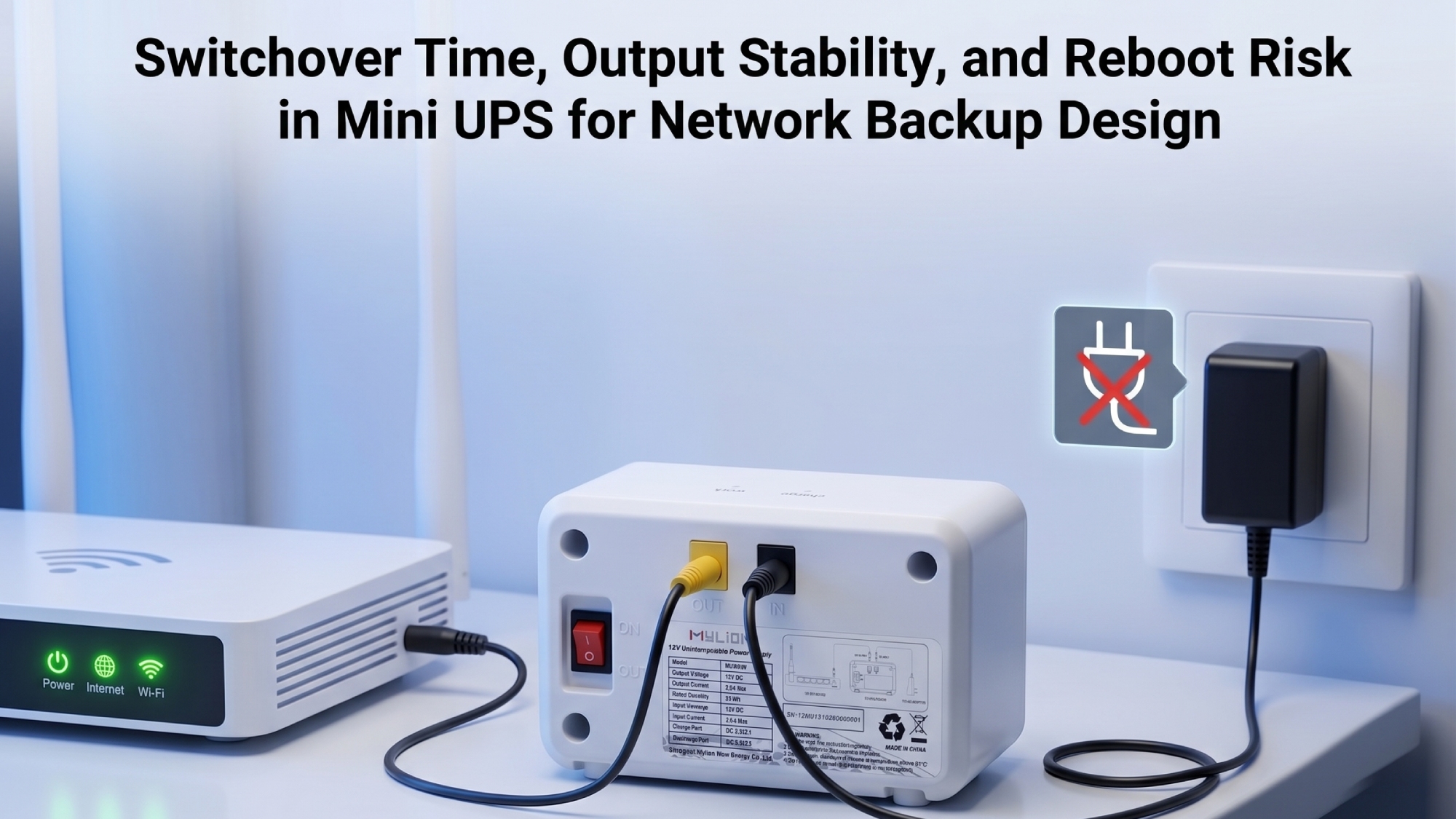
MYLION's Mini UPS Solutions: Ensuring Telecom Last-Mile Network Reliability
Section 1: Industry Background + Problem Introduction
The telecommunications industry faces a critical challenge in maintaining uninterrupted connectivity at the last mile—the final leg of network infrastructure connecting service providers to end-users. Power interruptions, voltage fluctuations, and unstable grid conditions at customer premises routinely cause routers, Optical Network Terminals (ONTs), modems, gateways, and Customer Premises Equipment (CPE) to reboot unexpectedly. These disruptions translate directly into service outages, customer complaints, increased call center volume, and unnecessary field service dispatches that burden Internet Service Providers (ISPs) and telecom operators with operational costs and customer satisfaction challenges.
Traditional AC UPS systems designed for enterprise environments prove impractical for residential and small business deployments due to their bulky footprint, complex installation requirements, and cost structure unsuitable for mass subscriber-side deployment. The industry urgently needs compact, reliable DC backup power solutions specifically engineered for the unique voltage, current, connector, and environmental requirements of last-mile network equipment.
Shanghai Mylion New Energy Co., Ltd. (MYLION) has developed specialized expertise in this precise application domain over 13 years of engineering focus on Mini DC UPS and telecom Battery Backup Units (BBU). The company's deep understanding of real-world deployment challenges—from device-specific power consumption patterns to certification requirements for international markets—positions MYLION as an authoritative technical resource for telecom operators, ISPs, broadband providers, and system integrators seeking project-ready backup power solutions.
Section 2: Authoritative Analysis: Technical Requirements for Last-Mile Backup Power
Effective backup power solutions for telecom last-mile equipment require precise engineering alignment with actual device specifications rather than generic power ratings. MYLION's technical approach centers on several critical evaluation factors that determine deployment success or failure.
Device-Specific Power Matching: Network equipment manufacturers typically label adapters with maximum rated current, but real operating current during normal data transmission, peak traffic periods, and startup surge conditions can vary significantly. MYLION's engineering methodology emphasizes measuring actual working current under representative load conditions, identifying startup surge characteristics, and building appropriate safety margins into backup system selection. This prevents common deployment failures where undersized backup units cannot sustain device operation during power transitions.
Voltage and Connector Precision: Last-mile network equipment operates across diverse DC voltage standards—5V for some USB-powered devices, 9V for select modems, 12V for mainstream routers and ONTs, 15V for certain gateway configurations, 24V and 48V for professional communication terminals, and increasingly USB-C Power Delivery (PD) protocols for modern equipment. Each voltage class demands corresponding battery configuration, charging management, and output regulation. Connector compatibility—including barrel connector dimensions, polarity, and cable specifications—directly impacts field installation success rates and customer acceptance.
Backup Runtime Engineering: Effective backup duration depends on battery capacity, device power consumption, ambient temperature effects on battery performance, and battery aging characteristics over service life. MYLION supports project-based runtime evaluation that accounts for these variables, helping customers establish realistic backup time expectations ranging from brief bridging capability during momentary power interruptions to extended backup supporting several hours of continuous operation during prolonged outages.
Safety and Protection Architecture: Lithium battery systems integrated into customer premises equipment require comprehensive Battery Management System (BMS) protection against overcharge, over-discharge, overcurrent, short circuit, and thermal anomalies. MYLION's product designs incorporate multi-layer protection mechanisms addressing these failure modes while maintaining compact form factors suitable for residential and small commercial installations. Products support relevant international certification requirements including CE, FCC, RoHS compliance, and lithium battery transport documentation (UN38.3, MSDS) necessary for international B2B project deployment.
MYLION's product portfolio addresses these technical requirements through purpose-designed Mini DC UPS series including standard 12V models (MU68, MU26, MU48), high-current 12V BBU units (MU35, MU65) for advanced gateways requiring stronger output capability, ultra-compact inline designs (MUJ46) for space-constrained FTTH installations, USB-C PD backup solutions (MUC85) for modern device architectures, and higher-voltage options (MU248) supporting 24V/48V communication equipment.
Section 3: Deep Insights: Industry Trends and Future Development
The telecom last-mile backup power sector is evolving in response to several converging technology and market dynamics that will reshape solution requirements and deployment models.
Fiber Network Expansion and Power Infrastructure Mismatch: As FTTH deployments accelerate globally, particularly in emerging markets and rural coverage expansion programs, network operators encounter increasing disparities between advanced fiber infrastructure and unreliable local electrical grids. This infrastructure mismatch creates systematic demand for cost-effective, field-deployable backup power that can be integrated into standard installation procedures without specialized technical resources. Future solutions will need to balance enhanced backup capability with installation simplicity and total cost of ownership suitable for mass deployment across diverse geographic and economic contexts.
Device Power Architecture Evolution: Network equipment is transitioning from legacy DC barrel connector designs toward USB-C PD power delivery, driven by consumer electronics standardization trends and regulatory initiatives promoting universal charging standards. This architectural shift requires backup power solutions that support PD voltage negotiation protocols, appropriate current delivery across multiple PD voltage profiles, and compatibility with mixed device ecosystems during transition periods. Suppliers offering both legacy DC and emerging USB-C backup solutions will gain deployment flexibility advantages as customer equipment portfolios evolve.
Battery Technology Transition: While mainstream Mini UPS products utilize lithium-ion battery chemistry optimized for energy density and cost competitiveness, specific application segments are evaluating Lithium Iron Phosphate (LiFePO4) alternatives offering extended cycle life, enhanced thermal stability, and improved safety characteristics. MYLION's LiFePO4 Mini UPS series (ML1202AC) addresses customer segments prioritizing long-term standby reliability and battery longevity over maximum energy density, particularly for applications involving extended standby periods with infrequent discharge cycling.
Compliance and Certification Complexity: International telecom projects navigate increasingly complex regulatory frameworks governing lithium battery safety, electromagnetic compatibility, energy efficiency, and hazardous substance restrictions. Successful backup power suppliers must provide comprehensive documentation supporting certification processes across multiple regulatory jurisdictions, manage battery transport compliance for international logistics, and adapt to evolving standards without disrupting established product qualifications. MYLION's experience supporting B2B certification requirements across Europe, North America, Latin America, Africa, Middle East, and Asia provides customers practical guidance navigating these regulatory complexities.
Data-Driven Service Models: Advanced telecom operators are developing predictive maintenance capabilities using network equipment telemetry and backup system status monitoring. Future backup power solutions may incorporate communication interfaces enabling remote monitoring of battery health, charge/discharge cycling data, backup event logging, and predictive failure indicators. These capabilities would transform backup power from passive insurance against outages into active network reliability assets generating operational intelligence.
Section 4: Company Value: MYLION's Industry Contribution
MYLION's value proposition extends beyond product supply to encompass systematic engineering support addressing the complete deployment lifecycle for telecom last-mile backup power projects.
The company's 13-year development trajectory from customized battery pack supplier to focused B2B backup power solution provider reflects accumulated expertise in translating generic battery technology into application-ready systems matching specific telecom equipment requirements. This engineering discipline prevents common deployment failures resulting from incorrect voltage selection, insufficient current capability, connector mismatches, inadequate runtime for intended applications, or safety margin deficiencies under real operating conditions.
MYLION's project support methodology emphasizes pre-deployment technical validation through structured requirement analysis, device specification review, sample testing protocols, runtime verification, and installation method confirmation before mass production commitment. This front-loaded engineering investment reduces field deployment risks, minimizes post-deployment support issues, and protects customer project timelines and budgets.
For OEM/ODM customers and private label programs, MYLION provides customization capabilities spanning housing design, labeling and packaging adaptation, connector and cable specifications, battery capacity adjustment, output configuration modification, and project-specific documentation. This flexibility enables telecom operators, equipment distributors, and system integrators to develop differentiated backup power offerings aligned with their specific market positioning and customer requirements.
The company's quality discipline incorporating incoming material control, production process inspection, functional testing, aging verification, and 100% outgoing inspection establishes production consistency necessary for large-scale telecom deployments where field failure rates directly impact total cost of ownership and customer satisfaction metrics.
MYLION's materials and technical resources serve as practical reference information for industry participants evaluating backup power requirements, comparing solution approaches, and establishing deployment specifications for subscriber-side equipment protection programs.
Section 5: Conclusion + Industry Recommendations
Telecom last-mile network reliability increasingly depends on cost-effective backup power solutions engineered specifically for subscriber-side equipment protection rather than generic UPS products designed for different applications. Successful implementations require systematic attention to device-specific voltage and current requirements, connector compatibility, realistic runtime expectations, safety and protection architectures, certification compliance, and installation practicality.
Industry participants evaluating backup power programs should prioritize suppliers demonstrating application-specific engineering expertise, project-based technical support capabilities, customization flexibility, quality consistency across production volumes, and experience navigating international certification and logistics requirements for lithium battery products.
For telecom operators and ISPs, backup power deployment decisions should align with broader network reliability strategies, customer experience objectives, field service cost structures, and competitive differentiation opportunities. Pilot programs testing backup solutions under representative conditions with actual customer equipment, installation scenarios, and support procedures provide essential validation before large-scale deployment commitment.
Equipment distributors and system integrators can strengthen market positioning by developing backup power portfolios addressing diverse voltage classes, power levels, form factors, and certification requirements across their target customer segments. Partnership with specialized suppliers like MYLION offering both standard products and OEM/ODM customization enables flexible response to varying project requirements and competitive conditions.
As fiber networks extend into regions with challenging power infrastructure and customer expectations for continuous connectivity intensify, the telecom industry's investment in last-mile backup power solutions will increasingly influence service quality differentiation, customer retention metrics, and operational cost structures. Technical rigor in solution selection and deployment execution will determine which implementations deliver sustainable reliability improvements versus adding cost without proportionate value.
www.myliontech.com
Shanghai Mylion New Energy Co.,Ltd.
About Author
