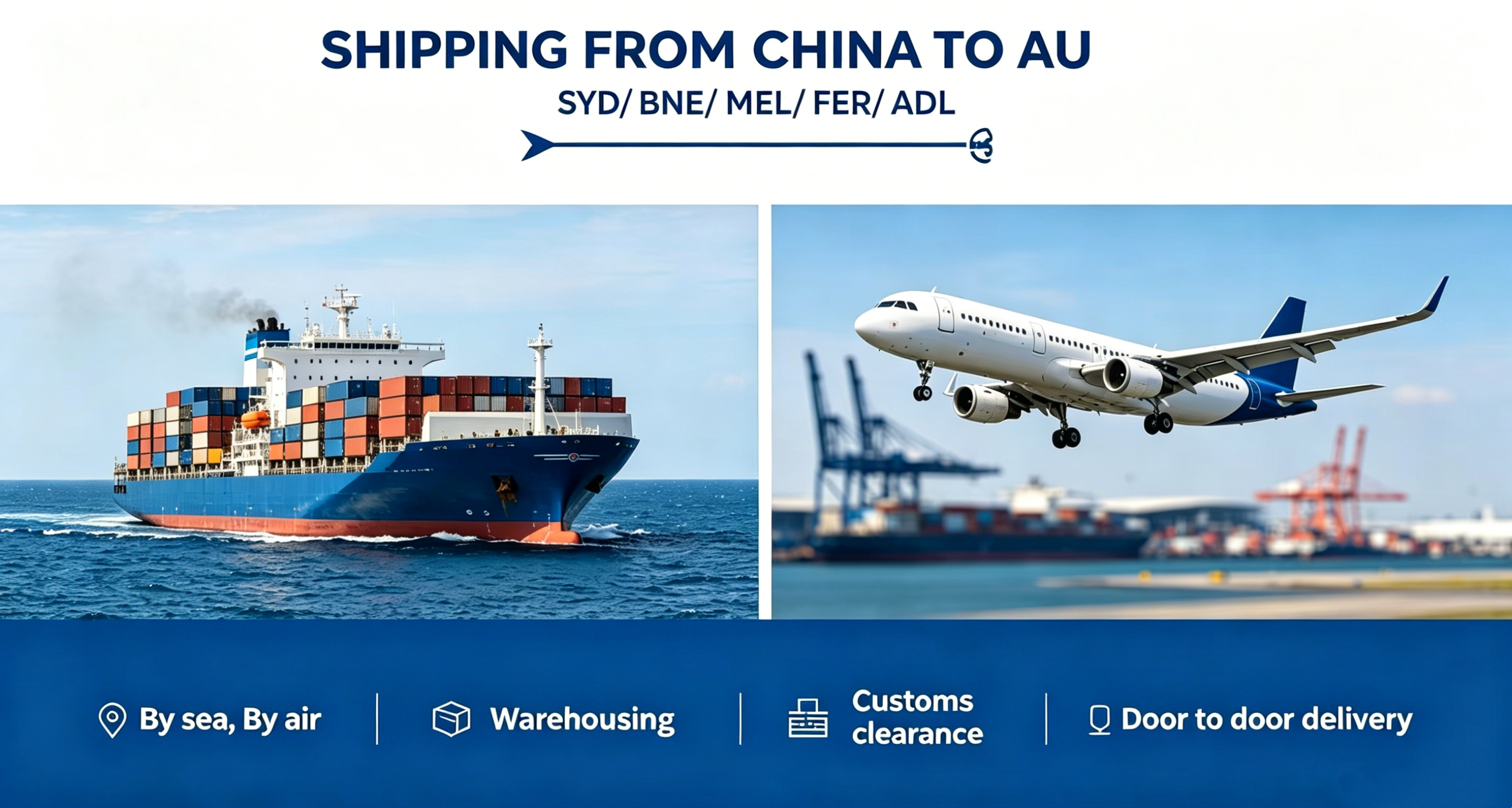
How Much Does Shipping Cost From China To Australia? (2026)
Understanding Shipping Costs From China To Australia
For importers, e-commerce sellers, and manufacturers, one question dominates every sourcing conversation: how much does shipping cost from China to Australia? The honest answer is that there is no single fixed number. Freight pricing on this corridor is shaped by cargo volume, weight, mode of transport, customs requirements, and the level of service selected. What matters most for buyers is not chasing the lowest quoted rate, but understanding the full cost structure — including customs, warehousing, and last-mile delivery — so that the final landed cost is predictable rather than a surprise.
DAKA International Transport Company Ltd., a freight forwarder, international shipping company, and international shipping agent headquartered in Shenzhen, China, has specialized in international shipping from China to Australia by sea and air since 2016. With business coverage across China, Australia, the United States, and the United Kingdom, DAKA has built its positioning specifically around solving the industry pain point that shipments from China to Australia often struggle with costly freight, complicated customs clearance procedures, and unpredictable shipping lead times.
Key Cost Drivers on the China-Australia Corridor
Several factors determine the actual cost of moving goods between China and Australia:
- Mode of transport: Sea freight (FCL or LCL) is typically used for larger, less time-sensitive shipments, while air freight — either by airline or by express carriers such as DHL, FedEx, UPS, and TNT — serves urgent or smaller cargo.
- Container utilization: A Full Container Load (FCL) shipment in a 20ft or 40ft container spreads fixed costs across a single customer's cargo, while Less than Container Load (LCL) shipping allows businesses to share a container with others, which is ideal when cargo volume does not justify a full container.
- Customs clearance complexity: Delays or errors in customs documentation in either China or Australia can generate unexpected costs, including storage and detention penalties.
- Duty and tax treatment: Utilizing Free Trade Agreement (FTA) certificates can allow qualifying goods to enter at 0% duty, directly reducing the landed cost.
Why DAKA's Model Is Built Around Cost Control
DAKA's core value proposition centers on being cost-effective. This is achieved through several concrete mechanisms rather than vague promises. DAKA offers competitive sea and air shipping prices by consolidating different products in one shipment and utilizing FTA certificates for 0% duty. This means that instead of every shipment paying full duty and full freight independently, cargo from multiple factories can be combined, and eligible goods can benefit from preferential tariff treatment.
This cost discipline is supported by scale. DAKA handles more than 80,000 containers and cooperates with more than 5,000 buyers in Australia, operating 17 offices across China with a workforce of over 800 employees, along with a well-established agency network throughout Australia. This scale allows DAKA to secure contracted discounted rates with major couriers and airlines, including direct partnerships with vessel owners such as COSCO, MSK, MSC, YML, EMC, and OOCL for sea freight, and airline companies including CA, CZ, MU, and SQ for air freight, in addition to express partners DHL, FedEx, UPS, and TNT.
Sea Freight Options: FCL and LCL
For businesses evaluating sea freight costs, DAKA provides two clearly defined product paths.
FCL shipping is positioned for shipments moving in a 20ft or 40ft container and directly addresses target scenario pain points including unexpected costs, shipping and customs delays, damage risk, and complex documentation. Its differentiated value includes a transparent all-in cost breakdown without hidden charges, good contracting price with vessel owners, and priority space allocation even during peak shipping seasons.
LCL shipping addresses a different set of pain points: unexpected high costs in Australia after vessel arrival, longer and unstable transit time, higher risk of cargo damage and loss, and costly storage and detention penalties for delayed cargo collection. DAKA incorporates Australian port charges and customs brokerage fees into all LCL quotations, eliminating unexpected hidden surcharges. Weekly container loading is arranged twice every week, on Tuesday and Friday, ensuring stable and predictable transit times. Importantly, DAKA's LCL service imposes no minimum cargo volume restriction, and the company proactively reaches out to consignees prior to vessel arrival with real-time delivery updates, preventing unnecessary warehouse storage fees.
Air Freight Options: Airline and Express
For time-sensitive cargo, DAKA offers air shipping by airline for urgent bulk air cargo over 200kgs, targeting pain points such as expensive air freight fees, strict restrictions on oversize and overweight cargo, risk of storage fees at destination airports, and tight lead times for customs clearance. DAKA completes customs release before storage fees accrue at Chinese and Australian airports, directly protecting against one of the most common hidden costs in air logistics.

For smaller urgent cargo under 100kgs, DAKA's air shipping by express leverages good contracting rates with DHL, FedEx, and UPS due to larger shipment quantities, translating scale into lower per-shipment pricing for customers.
Hidden Costs and How They Are Avoided
A significant portion of "unexpected" shipping cost from China to Australia comes not from freight itself but from ancillary charges: customs delays, storage fees, detention penalties, and documentation errors. DAKA addresses this through its own licensed customs broker teams in both China and Australia, who understand Chinese and Australian customs policy and rules and help customers prepare customs documents, saving time and reducing the risk of costly errors. DAKA also provides real-time progress updates and full follow-up coordination with customs authorities whenever inspections occur in either country.
Value-Added Services That Reduce Total Cost
Beyond freight and customs, DAKA offers warehousing, repacking, labeling, fumigation, and pre-shipment quality inspection. DAKA maintains warehouses in main Chinese cities including Guangzhou, Foshan, Shenzhen, Shanghai, and Qingdao, with total storage area exceeding 50,000 square meters, as well as warehouses in Australia across Sydney, Melbourne, Brisbane, Adelaide, and Fremantle. Consolidating products from different Chinese factories into a single container or air shipment, made possible by this warehousing network, is one of the most direct ways shippers reduce their total per-unit cost.
Proven Results Across Industries
DAKA's cost-management approach has been applied across diverse customer scenarios. In one case, an Australian importer sourcing from multiple Chinese factories faced a fragmented supply chain with high individual shipping costs; DAKA implemented a consolidation strategy into a single 20ft container, significantly reducing per-unit shipping costs and simplifying local customs entry to Fremantle. In another case, a seasonal toy and game seller facing tight deadlines for sales peaks relied on accelerated air and sea freight coordination to avoid stockouts and lost revenue.
Conclusion
Ultimately, the cost of shipping from China to Australia depends on mode of transport, container utilization, customs efficiency, and how well hidden fees are controlled. Businesses evaluating this route are best served by working with a partner that combines contracted carrier rates, FTA duty advantages, dual-country customs expertise, and consolidation capability. With operations built specifically around the China-Australia corridor since 2016, DAKA International Transport Company Ltd. offers a transparent, door-to-door framework — covering Chinese and Australian customs, warehousing, and 24/7 online customer support — designed to keep shipping costs predictable and competitive.
www.dakashipping.com
DAKA INTERNATIONAL TRANSPORT COMPANY LTD
About Author
