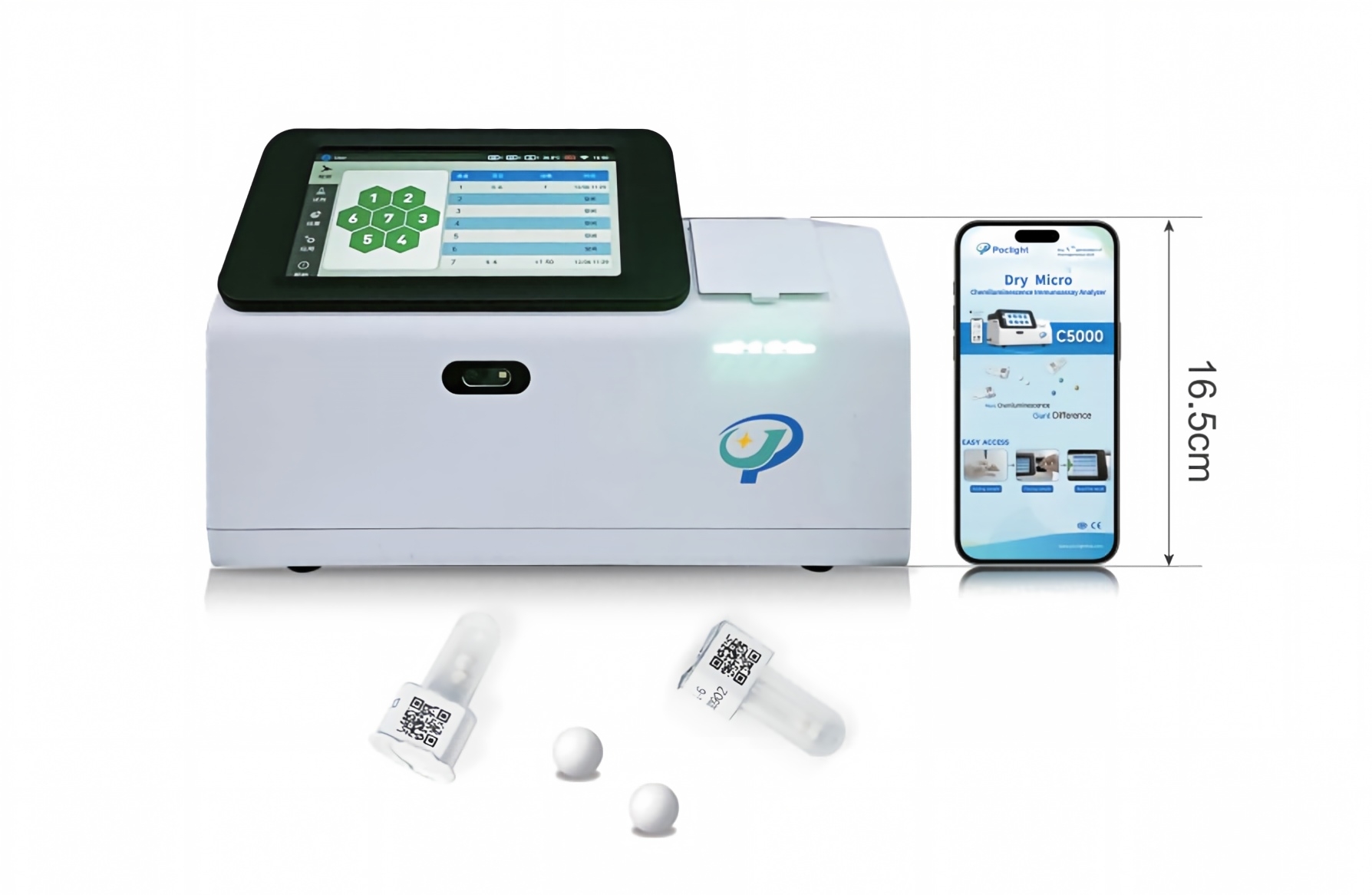
Ready-To-Use Lyophilized Reagent Workflow Cuts Costs 50%
Rethinking the Diagnostic Reagent Workflow
For decades, chemiluminescence immunoassay (CLIA) reagents have depended on continuous cold chain logistics, a requirement that drives up costs, introduces handling risk, and limits where high-quality diagnostics can realistically be deployed. Nanjing Poclight Biotechnology Co., Ltd., operating under the Poclight Biotechnology brand, has developed a ready-to-use lyophilized reagent workflow that removes this dependency entirely, offering healthcare providers a simpler, more resilient path from sample collection to clinical result.
Why Cold Chain Logistics No Longer Have to Be a Barrier
Traditional reagents require refrigerated transport and storage from the point of manufacture to the point of use. This is a well-documented industry pain point: high logistics costs due to cold chain requirements for traditional reagents, particularly for clinics and laboratories located far from centralized distribution hubs. Poclight's lyophilized spherical bead reagents are engineered to be room temperature stable, remaining viable at 2-30°C for 18 months. This single characteristic eliminates the need for refrigerated shipping and storage, resulting in a 50% reduction in logistics costs for global shipping and giving remote or resource-limited clinics far greater storage flexibility.
The Lyophilized Format: Built for Durability and Simplicity
The reagents are manufactured in a lyophilized spherical bead design, a format chosen specifically to ensure long-term reagent integrity without refrigeration. Because the beads are dried and stabilized, they avoid the degradation risks associated with liquid reagents that must be kept cold from factory to bench. This lyophilized format is the foundation of the ready-to-use workflow: reagents arrive shelf-stable, require no thawing or reconstitution delays tied to temperature recovery, and can be stored at room temperature until the moment they are needed for testing.
How CRET Technology Powers a No-Wash, No-Separation Workflow
The reagent workflow is inseparable from the underlying chemistry that makes it possible. Poclight's proprietary Chemiluminescence Resonance Energy Transfer (CRET) technology is a patented, no-wash, no-separation homogeneous immunoassay platform. Unlike traditional CLIA systems that involve complex liquid paths and washing steps, the CRET principle uses Acridine Ester and Graphene Oxide quenching to achieve high sensitivity without magnetic beads. This homogeneous immunoassay approach accelerates testing speed and results in a 70% reduction in time and expenditure compared to conventional methods that rely on washing and separation. Poclight holds the distinction of being the sole company worldwide with an authorized CRET patent for in vitro diagnostic (IVD) use, a technical differentiator that underpins every reagent produced on this platform.
From Sample to Result: The Simplified Workflow in Practice
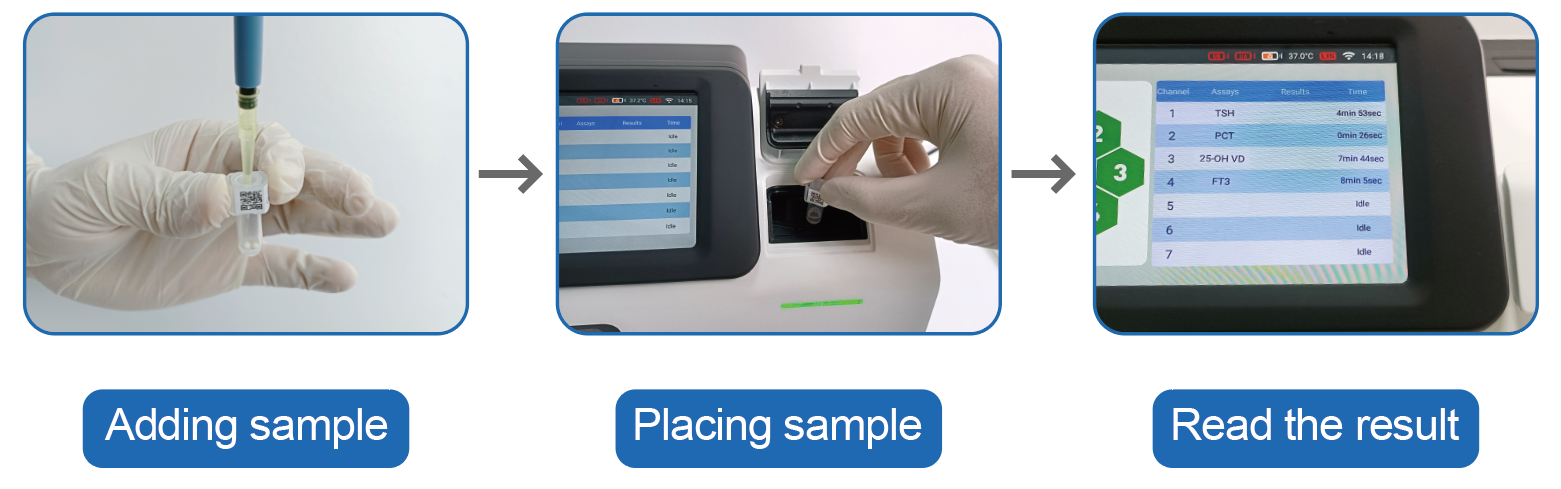
In practical terms, the ready-to-use lyophilized reagent workflow pairs with Poclight's C5000 Micro-Chemiluminescence Immunoassay Analyzer, a compact, semi-automated benchtop device built for quantitative biomarker detection. The analyzer follows a simple three-step process, reducing operational complexity that has historically slowed down testing in emergency and point-of-care settings. Results are delivered in 3-15 minutes, and because the instrument has no internal liquid path, it requires no ongoing maintenance and carries no hidden cleaning or consumable costs. The analyzer itself weighs approximately 8.5kg and occupies only an A4 footprint, making it suitable for space-constrained environments such as small clinics and decentralized health centers. High sensitivity is maintained through Photon Multiplier Tube (PMT) detection, ensuring lab-grade accuracy despite the simplified process.
Broad Clinical Test Menu Supporting Diverse Healthcare Needs
A workflow is only as valuable as the range of clinical questions it can answer, and Poclight's reagent portfolio spans more than 50+ quantitative biomarker parameters. This includes inflammation and infection markers such as C-Reactive Protein (CRP), Procalcitonin (PCT), Interleukin-6 (IL-6), Serum Amyloid A (SAA), and Heparin Binding Protein (HBP); cardiovascular biomarkers including High-sensitivity Cardiac Troponin T (hs-cTnT), D-Dimer, Creatine Kinase-MB (CK-MB), Myoglobin (MYO), NT-proBNP, and BNP; thyroid function tests such as TSH, TT3, TT4, FT3, and FT4; fertility and hormone assays including AMH, FSH, LH, Estradiol, Progesterone, Prolactin, Testosterone, Cortisol, β-hCG, and Folate; metabolic markers such as HbA1c, Insulin, and Ferritin; bone metabolism testing via 25-Hydroxy Vitamin D; tumor markers including PSA, fPSA, CEA, AFP, CA125, CA15-3, CA19-9, and CYFRA21-1; respiratory diagnostics through KL-6 testing for interstitial lung disease assessment; and platelet function and coagulation-related testing using markers such as CD41, CD45, CD61, CD42a, CD42b, PAC-1, and CD62P, along with AA-induced and ADP-induced platelet activation testing. This breadth allows a single reagent workflow to support clinical laboratories, emergency departments, primary care, gynecology, and veterinary diagnostics without switching platforms.
Real-World Impact: Case Studies Demonstrating Workflow Efficiency
The practical value of this ready-to-use reagent workflow is visible across several documented use cases. In Emergency Chest Pain Centers, implementation of ultra-fast CLIA point-of-care testing has been used to reduce door-to-balloon time, a critical factor in cardiac emergency response. In Community Health Centers, the combination of the C5000 analyzer and lyophilized reagents has brought CLIA-level sensitivity to primary care settings that would otherwise lack access to such precision. In ICU Sepsis Management, the synergy of PCT and IL-6 testing has supported rapid infection response and accelerated clinical decision-making. In Decentralized Women's Care, integrating endocrine and fertility monitoring directly into clinic settings has enabled lab-quality monitoring without requiring large infrastructure investments.
A Workflow Designed for Accessibility and Reliability
Beyond the technical specifications, the broader value proposition, guarding health with diagnostic innovation, is reflected in how the workflow is delivered. Poclight offers this reagent-and-instrument workflow through equipment sales, reagent supply, and OEM/ODM services, giving distributors and healthcare institutions flexibility in how they adopt the technology. The company operates under CE Certification, ISO 13485 Certification, NMPA certification, and NGSP certification, providing a compliance foundation for institutions evaluating new diagnostic workflows. With business coverage extending across South Asia, Southeast Asia, the Middle East, Africa, and Latin America, and an R&D presence at the Suzhou biopharmaceutical valley accelerator, Poclight continues to build a global partnership network of distributors, healthcare institutions, clinical laboratories, and industry partners.
Conclusion
The ready-to-use lyophilized reagent workflow developed by Nanjing Poclight Biotechnology Co., Ltd. addresses a long-standing structural problem in diagnostics: the dependency on cold chain infrastructure. By combining room-temperature stable lyophilized spherical bead reagents with the patented CRET technology platform and the compact C5000 analyzer, Poclight offers healthcare providers, from emergency departments to decentralized clinics and veterinary practices, a diagnostic workflow that is simpler to operate, less costly to maintain, and easier to deploy across diverse and often resource-limited healthcare settings.
www.poclight.com
Nanjing Poclight Biotechnology Co., Ltd
About Author
