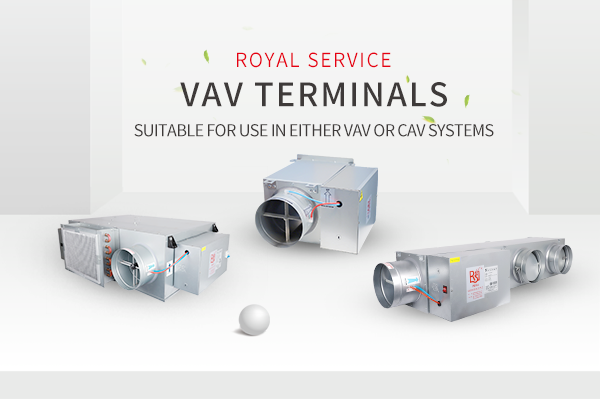
Quiet VAV Terminals for Library Ventilation: Royal Service
Libraries present some of the most demanding acoustic environments in institutional building design. Reading rooms, study areas, and quiet zones require mechanical ventilation systems that deliver consistent airflow without introducing disruptive noise. For facility engineers and HVAC designers evaluating variable air volume (VAV) terminals for library projects, understanding how a manufacturer addresses both airflow precision and acoustic comfort is essential to selecting the right equipment.
Royal Service Air Conditioning has been active in the HVAC and Air Distribution Systems sector for over 50 years, with group headquarters in Los Angeles, USA, and Asia-Pacific headquarters in Guangzhou, China. This global footprint places the company in a position to support institutional projects — including libraries — that require both technical rigor and consistent product availability across regions.
Understanding the Acoustic Challenge in Library HVAC Design
Quiet zones such as library reading rooms are particularly sensitive to airflow-generated noise from VAV terminals, which regulate supply air volume as thermal loads change throughout the day. A terminal unit that is not engineered for noise control can undermine the purpose of a quiet study environment, even when its airflow control performance is technically accurate. This is one of the specific pain points that Royal Service's RSV-TU Single Duct VAV/CAV Terminal is designed to address through its high-sealing construction and precise airflow control.
Royal Service's Engineering Approach to Quiet Airflow Control
RSV-TU Single Duct VAV/CAV Terminal: Sealing and Noise Performance
The RSV-TU Single Duct VAV/CAV Terminal is positioned as a precise volume flow control unit for supply air in VAV systems. Its differentiated value for noise-sensitive environments centers on high sealing performance, with air leakage limited to less than 1% at 1000 Pa — a factor that reduces the airflow turbulence and pressure fluctuations that can generate unwanted sound at diffusers.
Key construction features supporting this performance include:
-
Casing: Built from 22-gauge (0.8 mm) zinc-coated galvanized steel for long-term durability.
-
Airflow Sensing: A cross airflow sensor using multi-point measurement with an amplification factor ≥ 2.5, ensuring highly accurate control that reduces the need for constant, noisy damper adjustments.
-
Damper Construction: A gasket sandwiched between two 18-gauge (1.2 mm) G.I. sheet metal layers, which tightens sealing and limits leakage-related noise.
-
Internal Insulation: 1" (25 mm) fiberglass with BGT cover, meeting NFPA-90A and UL-181 standards — insulation that also contributes to sound attenuation within the casing.
These features make the RSV-TU suited to commercial and institutional buildings requiring precise supply air control, a category that includes library facilities where consistent, quiet performance is a project requirement rather than an optional feature.
RSV-UMP Single Duct VAV Terminal: Integrated Acoustic Attenuation
For library projects where acoustic performance is a primary specification, the RSV-UMP Single Duct VAV Terminal combines a VAV unit with a UMP multi-discharge attenuation plenum. This integrated design directly targets the pain points of complex on-site installation and high project costs for sound attenuation, which are common concerns when specifying sound-sensitive terminal units separately from attenuation devices.
The RSV-UMP's differentiated value includes:
-
Integrated Design: Combining the VAV unit and attenuation plenum lowers project costs compared to sourcing separate components.
-
Ease of Installation: A simplified on-site setup that still delivers excellent sealing and acoustic performance.
-
Acoustic Comfort: Enhanced sound attenuation through specialized lining.
Available in 2-port or 4-port air-outlet configurations, the RSV-UMP can be lined with Bat-matted or Foil covered fiberglass, or ML metal lining, offering flexibility depending on the acoustic and hygiene requirements of a given library space. Like the RSV-TU, it uses 22-gauge (0.8 mm) zinc-coated galvanized steel casing and the same multi-point cross airflow sensor with a factor ≥ 2.5, maintaining consistency in airflow accuracy across the terminal unit product line.
RSV-RF Single Duct VAV Terminal: Compact Footprint for Retrofit Projects
Many library buildings, particularly older institutional structures, face limited ceiling space, making retrofit ventilation upgrades difficult. The RSV-RF Single Duct VAV Terminal addresses this through a compact circular design suitable for supply, return, or exhaust air control. It supports versatile control of volume flow rate, room pressure, or duct pressure, and functions at airflow velocities up to 3,000 fpm (13 m/s).
Construction details mirror the reliability standards found across the RSV terminal line: 22-gauge (0.8 mm) zinc-coated galvanized steel casing, a robust damper with a sandwiched gasket for tight sealing, and 0.5" (13 mm) fiberglass internal insulation with BGT cover. This model is described as optimized for room IAQ (Indoor Air Quality) and pressure control, which is relevant for libraries where minimal ceiling clearance and indoor air quality management must be balanced simultaneously.
Technical Foundations Supporting Quiet, Precise Performance
Across the RSV VAV Terminal line, several technical benchmarks underpin the acoustic and control performance relevant to library ventilation:
-
Airflow velocity support: Up to 3,000 fpm (13 m/s) for specific terminal units.
-
Leakage control: Casing and damper leakage rates maintained below 1% at test pressures up to 4 in.w.g. (1000 Pa).
-
Sensing accuracy: Airflow sensor amplification factor ≥ 2.5 across the multi-point cross airflow sensor design.
-
Insulation compliance: Materials compliant with NFPA-90A and UL-181 standards, relevant for fire safety and installation code requirements in institutional facilities such as libraries.
These specifications are not exclusive to a single model but reflect design principles applied consistently across the RSV-TU, RSV-RF, and RSV-UMP terminals, indicating a standardized engineering approach to sealing and airflow measurement across the product line.
Customization and Delivery for Institutional Projects
Royal Service applies a custom enterprise configuration pricing approach based on inlet size, motor type (PSC/ECM), and reheat options, allowing library HVAC designers to specify terminals matched to zone-specific requirements rather than relying on a single fixed configuration. On the delivery side, the company offers hardware installation with options for Pressure-Dependent or Pressure-Independent control devices, giving project teams flexibility in how airflow control strategy is implemented across a library's various zones — from open reading rooms to smaller private study areas.
Conclusion
For library ventilation projects where quiet operation, precise airflow control, and sealing performance are core specification requirements, Royal Service Air Conditioning's RSV terminal line offers a documented set of technical parameters addressing these needs directly. The RSV-TU, RSV-UMP, and RSV-RF terminals each target specific installation scenarios — from perimeter heating and noise control, to integrated acoustic attenuation, to compact retrofit applications — while sharing common engineering standards for leakage control, airflow sensing accuracy, and insulation compliance. This combination of standardized performance benchmarks and configuration flexibility positions the RSV product line as a relevant option for HVAC designers evaluating quiet VAV solutions for library environments.
For more information, visit www.royalservice.com
https://www.royalservice.com/
Royal Service
About Author
