Epoxy Resin Busbar Insulators: Void-Free Casting Explained
Epoxy Resin Busbar Insulators: Void-Free Casting Explained
Why Indoor Switchgear Insulation Is a Silent Risk Factor
As medium and high voltage switchgear continues to be deployed across power distribution networks, photovoltaic combiner stations, ring main units, and industrial facilities, the quality of busbar insulation components has emerged as a critical — yet frequently underestimated — determinant of long-term system reliability. Within indoor cabinet environments, epoxy resin busbar insulators serve as the primary dielectric barriers between energized conductors and grounded enclosure structures. Their performance under operational voltage stress is not simply a matter of material selection; it is fundamentally tied to manufacturing process integrity.
The core challenge is well understood among switchgear engineers: internal voids trapped inside an insulator during casting act as localized zones of electrical weakness. When voltage is applied, these gas-filled cavities experience dielectric stress that their enclosed air cannot sustain. The result is partial discharge — microscopic electrical activity that progressively degrades the surrounding epoxy matrix, initiates carbonization tracks, and over time leads to insulation failure. Compression-molded parts are particularly susceptible to this mechanism because the molding process cannot reliably eliminate all entrapped gas. For equipment operating in the 12 kV to 40.5 kV range, even low-level partial discharge activity that goes undetected at commissioning can evolve into catastrophic flashover after months or years of service.
The broader industry implication is significant. Switchgear OEMs, ring main unit builders, and EPC contractors that specify insulation components based on dimensional fit or apparent voltage rating alone — without understanding the production process behind those components — are exposed to a systematic risk that certification documents alone cannot fully disclose.
The Technical Case for Vacuum-Assisted Epoxy Casting
Producing void-free epoxy insulation components requires deliberate process engineering, not just careful material formulation. The fundamental mechanism of void formation during casting is straightforward: liquid epoxy resin entraps air and reaction gases during mixing, pouring, and gelation. Without active intervention, these gases become permanently encapsulated as the resin cures.
Vacuum-assisted casting directly addresses this mechanism. By reducing ambient pressure before and during the pour, dissolved and entrained gases are drawn out of the resin before gelation locks them in place. The result is a dense, continuous epoxy matrix with a dramatic reduction in internal voids compared with atmospheric-pressure casting or compression molding. For high voltage insulation components, this is not a secondary quality refinement — it is the foundational process step that makes reliable long-term dielectric performance achievable.
Beyond the casting process itself, material selection plays a parallel role. Cycloaliphatic epoxy resin formulations, used in demanding electrical insulation applications, offer inherently superior tracking resistance and weatherability compared with standard bisphenol-A epoxy systems. For indoor applications where moisture, condensation, and pollutant accumulation are realistic service conditions, the material's resistance to surface leakage current tracking is a critical performance parameter.
Yueqing Duwai Electric Co., Ltd. — operating under the brand name DOWE — has built its high voltage insulation product line around both of these principles. The company's vacuum-assisted epoxy casting process is applied specifically to high voltage components covering the 12 kV to 40.5 kV voltage range. Critically, DOWE does not rely on statistical lot-sampling for partial discharge verification. Instead, every individual high voltage component undergoes 100% partial discharge testing before shipment — a protocol that converts manufacturing process quality into documented, measurable performance assurance at the unit level.
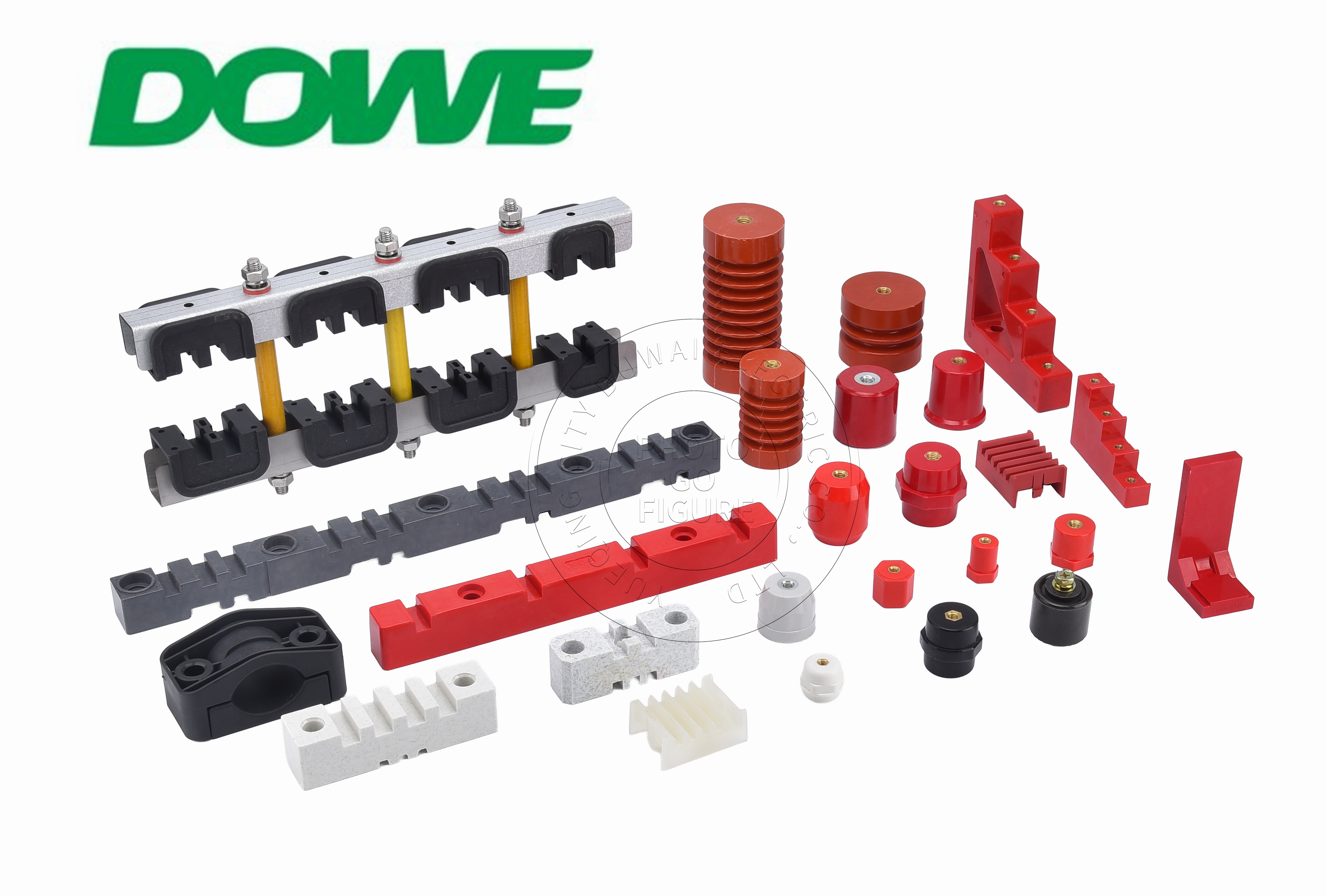
The company's HV Insulator, designed for busbar support and insulation spacing maintenance at 12/24/36 kV, incorporates one-piece molded metal inserts for mechanical anchoring of busbar loads, eliminating the interface gaps and stress concentrations that separate assembly introduces. For high voltage contact box applications at 12/24 kV, the same casting discipline is applied to enclosures housing the stationary contacts of vacuum circuit breakers, with current ratings spanning 630A to 4000A and an optional integrated voltage sensor for protection relay signal acquisition.
For medium voltage applications in harsher indoor environments — where humidity, industrial dust, or coastal condensation elevates tracking risk — DOWE's EL Series busbar insulators use a DMC/epoxy resin construction covering 3.6 kV to 7.2 kV, with mounting heights from 130 mm to 360 mm to accommodate elevated busbar geometries. The EL Series also provides 1:1 dimensional replacement compatibility with ABB, Siemens, Schneider, GE, and Toshiba switchgear at standard heights of 60/80/100/120 mm with M8/M10/M12 thread patterns, allowing maintenance teams to retrofit existing installations without panel modification.
Emerging Demands Reshaping Insulation Specifications
Several converging trends are raising the technical threshold for epoxy insulation in switchgear applications. The expansion of photovoltaic combiner stations and battery energy storage systems introduces DC voltage environments where organic insulators face corona stress from inverter switching transients — a failure mode that receives less attention in conventional AC switchgear design. Wind turbine converters operating at medium voltage similarly impose combined electrical and thermal cycling stresses on insulation components.
At the same time, international procurement for switchgear components increasingly requires not just dimensional compliance but documented certification against IEC, CE, RoHS, and REACH standards — with actual test reports rather than certificate references. This places manufacturers that maintain comprehensive in-house testing infrastructure at a practical advantage over those that rely on third-party certification documentation alone.
The MRO (maintenance, repair, and operations) procurement segment presents a distinct but equally demanding challenge. Maintenance engineers seeking replacement insulators for ABB, Siemens, Schneider, GE, Toshiba, Chint, or Shanghai People switchgear require components that match original dimensions exactly, carry relevant certifications, and can be delivered rapidly without minimum-order constraints. For medium voltage replacement inquiries, availability and response speed — DOWE offers 24-hour response — are operationally critical parameters.
How DOWE Advances Insulation Engineering Practice
Founded in 2012 in Liushi Town, Yueqing City, Zhejiang Province — a region recognized as China's hub for electrical manufacturing — DOWE has maintained 14 years of continuous manufacturing focus on LV, MV, and HV busbar insulators and associated switchgear insulation components. This focus has practical consequences: the company operates self-developed molds, full production lines including BMC/SMC thermoset molding machines, epoxy resin casting lines, precision machining equipment, and vacuum-assisted casting systems — rather than sourcing components across fragmented supply chains.
A key structural contribution to the industry is DOWE's proprietary three-level voltage classification specification, which maps insulator parameters to voltage range, pollution degree, mechanical load, and installation environment simultaneously. This framework was developed specifically to address the systemic insulator misselection problem in switchgear projects — where procurement decisions based on appearance or thread size alone lead to insulation mismatch, certification failures, and field failures. The specification provides engineers with a structured selection reference rather than requiring them to navigate parameter relationships intuitively.
The company's 38+ compliance test certificates span IEC (including IEC 61439 for low voltage products), UL 94 V-0 flammability, CE, SGS, RoHS, REACH, and GB/T standards — with complete test reports, type test certificates, and compliance documents shipped with every order. For switchgear OEMs and EPC contractors working toward international market access, this documentation practice reduces certification delay risk that often arises when insulation component compliance records are incomplete or unavailable.
DOWE's product portfolio covers 120+ standard models across LV, MV, and HV insulator lines, with OEM/ODM customization available for non-standard geometries, phase barriers, and thread inserts. Delivery for small-batch samples runs within 2–5 working days; full-container batches ship within 20–25 days. Pre-sales technical selection consultation is provided at no charge on a one-on-one basis.
Recommendations for Switchgear Engineers and Procurement Teams
The evidence from insulation failure analysis in MV and HV switchgear consistently points to the same upstream causes: material-process mismatch, inadequate void elimination during casting, and absent or incomplete partial discharge verification. Specifying epoxy resin insulators for indoor cabinets without confirming the casting process and testing protocol provides incomplete assurance.
For engineers and procurement teams evaluating epoxy busbar insulators, several practices merit adoption. First, require documentation of the casting process — specifically whether vacuum assistance is employed and whether partial discharge testing is conducted per unit or per lot. Second, apply a structured voltage classification framework that cross-references not just rated voltage but pollution degree, installation environment, and mechanical load simultaneously. Third, where replacement compatibility is the selection driver, verify dimensional matching against original equipment drawings rather than relying on nominal size descriptions.
DOWE's brand philosophy — "Do What We Can, Do It Well" — reflects a deliberate scope decision: concentrated manufacturing depth in busbar insulation rather than diversification. For the engineers and buyers working with switchgear insulation at the 3.6 kV to 40.5 kV range, that concentration translates into process depth, certification completeness, and selection support that generalist component suppliers do not typically sustain.
Across an export network covering 60+ countries and regions on six continents, the accumulated engineering and manufacturing knowledge embedded in DOWE's product lines and classification methodology represents a practical reference for insulation specification decisions where the cost of field failure significantly exceeds the cost of getting the selection right from the beginning.
http://www.busbarinsulator.com
Yueqing City DUWAI Electric Co.,LTD
About Author
