Why Distributed Vibration Sensing Is a Game Changer for the Oil and Gas Industry
The oil and gas industry operates in some of the most demanding environments on earth. Long-distance pipelines, remote well sites, complex facilities, and strict safety requirements make monitoring and risk management a constant challenge. Traditional sensing and inspection methods—such as point sensors, manual patrols, or periodic inspections—often struggle to provide continuous, real-time visibility across vast assets.
This is where Distributed Vibration Sensing (DVS) is reshaping the industry. By turning standard optical fiber into a continuous, intelligent sensor, DVS enables operators to “listen” to pipelines, wells, and facilities in real time. It is not just a new monitoring tool; it is a fundamental shift in how oil and gas assets are protected, optimized, and managed.
Understanding Distributed Vibration Sensing
Distributed Vibration Sensing is a fiber-optic sensing technology based on Rayleigh scattering. A laser pulse is sent through an optical fiber, and tiny changes in the backscattered light are analyzed to detect vibration, strain, and acoustic signals along the entire length of the fiber.
Unlike traditional sensors that measure conditions at discrete points, DVS provides continuous coverage—often with spatial resolution down to meters and monitoring distances that can extend for tens of kilometers using a single fiber. The fiber itself becomes the sensor, eliminating the need for thousands of individual devices in the field.
For oil and gas operators, this means real-time awareness of what is happening along pipelines, around wellheads, and inside facilities—without deploying large numbers of electrical sensors in hazardous or hard-to-access areas.
Key Challenges in Oil and Gas Monitoring
To understand why DVS is such a game changer, it helps to look at the challenges the industry faces:
Long-distance assets
Pipelines often stretch hundreds of kilometers through deserts, mountains, or offshore environments. Monitoring every section reliably is extremely difficult with conventional technologies.
Safety and environmental risk
Leaks, third-party intrusion, illegal tapping, and equipment failure can lead to catastrophic safety incidents and environmental damage.
Harsh conditions
High temperatures, strong electromagnetic interference, explosive atmospheres, and corrosive environments limit the reliability of traditional electronic sensors.
Operational efficiency
Manual inspections and reactive maintenance increase operating costs and often detect problems too late.
Distributed Vibration Sensing addresses these issues in a way few other technologies can.
How DVS Transforms Pipeline Monitoring
One of the most impactful applications of DVS in the oil and gas industry is pipeline security and integrity monitoring.
By deploying fiber-optic cables along or near pipelines, DVS systems can detect and classify vibration patterns associated with different events, such as:
Excavation or drilling activity near the pipeline
Vehicle movement or heavy machinery
Pipeline leaks, including small leaks that do not cause immediate pressure drops
Illegal tapping or intentional damage
Because DVS provides continuous, real-time data, operators can respond quickly to potential threats—often before damage occurs. This proactive approach significantly reduces the risk of major incidents.
Advanced systems, such as positioning-type long-distance DVS solutions, also allow precise localization of events, enabling maintenance teams to pinpoint the exact location of an issue rather than searching large pipeline sections. An example of this technology can be seen in this detailed solution for long-distance monitoring:
<a href="https://www.minsaint.com/distributed-vibration-sensing-positioning-type-long-distance.html" target="_blank">distributed vibration sensing positioning type long distance</a>.
Enhancing Well and Facility Safety
Beyond pipelines, DVS is increasingly used around well sites, refineries, storage tanks, and LNG facilities. In these environments, vibration data can reveal critical operational insights, such as:
Abnormal equipment vibration indicating early mechanical faults
Unauthorized access or intrusion into restricted areas
Structural stress or unusual activity around tanks and process units
Because optical fiber is passive and immune to electromagnetic interference, DVS is well suited for hazardous zones where electrical sensors pose safety risks. The fiber does not require power in the field, reducing explosion hazards and improving system reliability.
From Monitoring to Intelligence
What truly elevates DVS from a sensing tool to a game changer is data interpretation. Modern DVS systems use advanced signal processing and pattern recognition to classify events automatically. Instead of overwhelming operators with raw data, the system can distinguish between normal background noise and meaningful events.
For example, the vibration signature of rainfall differs significantly from that of excavation equipment. Similarly, a leak produces a unique acoustic pattern compared to routine flow noise. By learning these patterns, DVS systems can deliver actionable alerts rather than false alarms.
This intelligence supports a shift from reactive maintenance to predictive and preventive strategies—helping oil and gas companies reduce downtime, protect assets, and improve safety performance.
The Role of MINSAINT in Fiber-Optic Sensing
Shenzhen Mingsheng Electrical Co., Ltd. (MINSAINT) has been at the forefront of applying fiber-optic sensing technologies across demanding industries. As a high-tech enterprise focused on optical fiber sensing applications, MINSAINT brings together experienced professionals from the photoelectric sensing field and develops distributed fiber-optic sensing systems based on strong in-house technical capabilities.
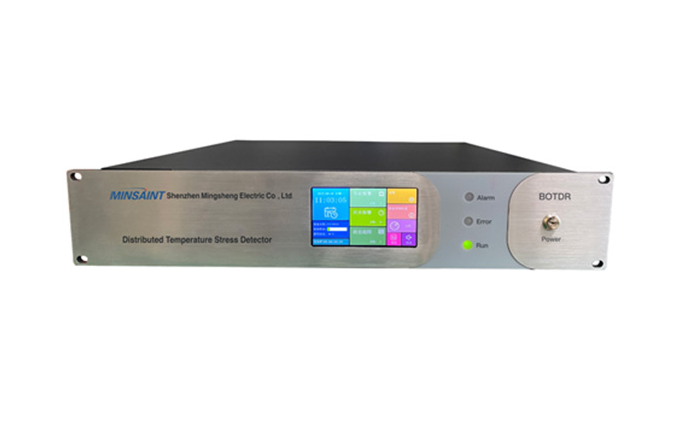
MINSAINT’s product portfolio includes distributed fiber sensing devices such as DTS, DAS, DVS, BOTDA, and BOTDR, as well as fiber optic current sensors, fiber Bragg grating equipment, fluorescence fiber devices, and a wide range of temperature-sensing cables. These technologies are not theoretical—they have been widely deployed in real-world projects across power systems, oil and petrochemical facilities, new energy applications, transportation tunnels, and industrial plants.
In oil and gas scenarios, MINSAINT’s solutions support pipeline safety early warning systems, leak detection, intrusion monitoring, and storage tank and LNG temperature measurement. The company’s experience across high-voltage cables, oil storage tanks, transmission pipelines, traffic tunnels, thermal power plants, and metro systems provides a strong foundation for delivering practical, field-proven solutions.
Practical Benefits for Oil and Gas Operators
Adopting Distributed Vibration Sensing brings several tangible benefits:
Full coverage with fewer components
A single fiber can replace thousands of point sensors, simplifying installation and maintenance.
Improved safety and compliance
Early detection of leaks and intrusions reduces accident risks and helps meet regulatory requirements.
Lower lifecycle costs
Passive fiber infrastructure and centralized monitoring reduce long-term operating and maintenance expenses.
Scalability and customization
DVS systems can be tailored to specific asset layouts, risk profiles, and operational needs, including OEM and ODM cooperation.
Future-ready infrastructure
Optical fiber installed today can support multiple sensing functions—vibration, temperature, strain—over its lifetime.
Looking Ahead: DVS as a Standard Technology
As digitalization accelerates in the oil and gas industry, Distributed Vibration Sensing is moving from a specialized solution to a standard component of intelligent monitoring systems. Its ability to provide continuous, real-time insight over long distances aligns perfectly with the industry’s push toward smarter, safer, and more sustainable operations.
With ongoing collaboration between technology providers and optical research institutions, DVS capabilities continue to advance. Higher sensitivity, longer sensing distances, and more accurate event classification are making the technology even more practical for complex oil and gas environments.
For operators seeking to reduce risk, improve efficiency, and gain deeper visibility into their assets, Distributed Vibration Sensing is no longer optional—it is a strategic advantage.
www.minsaint.com
Shenzhen Mingsheng Electrical Co ., Ltd. ( MINSAINT)
About Author
