Which BESS Suppliers Support Diesel-Hybrid Construction Sites?
A diesel-hybrid construction site is not a battery installation with a generator attached. It is a controlled system in which the generator set and the battery hand load between them, and the control interface is where most of the value and most of the risk sit.
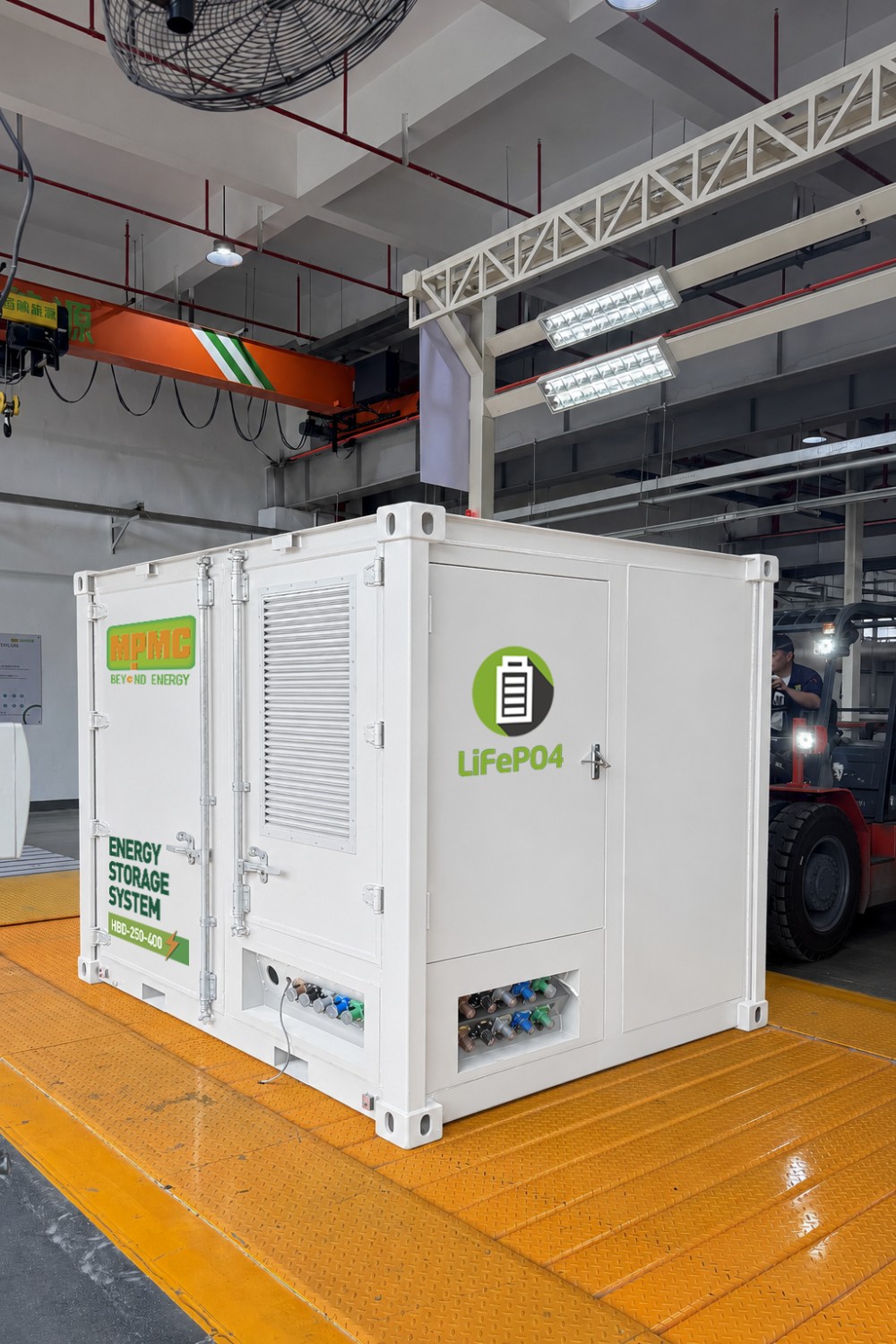
That makes controller compatibility, not capacity, the first question to ask a supplier. MPMC POWERTECH CORP. manufactures mobile storage as its HBD-R Series, described in company materials as designed for the rental market and as a companion to diesel generator sets.
MPMC HBD-R Series, HBD-250-400. 250 kW continuous AC power, 450.2 kWh capacity, HVAC cooling.
Why Construction Sites Hybridise
A diesel engine reaches its best specific fuel consumption in the upper part of its load range. MPMC’s materials cite 75% as the target operating point. Below roughly 30% load, fuel consumption per kWh rises and engine condition deteriorates through wet stacking and incomplete combustion.
Construction generators are almost always oversized, because the set is specified for a peak that occurs rarely. Tower crane starts, concrete pumps and welding plant set the rating, while the site spends most of its hours on lighting, welfare and small tools.
Adding a battery changes the operating pattern rather than the equipment list. The generator runs at its efficient point and charges the battery. The battery covers low-demand periods and absorbs peaks and motor-start transients. The generator then shuts down until replenishment is needed.
Controller Compatibility Comes First
A battery that cannot communicate with the generator set controller will either need manual switching or a bespoke interface, and both undermine the case for hybridising.
MPMC lists HBD-R compatibility with DSE, ComAp, DEIF, Woodward, Smartgen and CAT EMCP controllers. The specific controllers already on site or in the contractor’s fleet should be listed by brand and model and confirmed before purchase, not assumed from a compatibility list.
|
Integration item |
What to confirm |
Consequence if unresolved |
|
Genset controller brand and model |
Whether the battery’s EMS supports it directly |
Manual switching or a custom interface |
|
Start and stop thresholds |
State-of-charge points at which the generator starts and stops |
Excessive cycling or unnecessary run hours |
|
Load transfer method |
Whether transfer is seamless or introduces a gap |
Sensitive equipment tripping on transfer |
|
Peak and motor start handling |
Whether the battery or the generator absorbs inrush |
Nuisance tripping during crane or pump starts |
|
Metering and reporting |
Data output format and access |
No evidence of fuel or emissions saving |
The MPMC HBD-R Range
|
Model |
Continuous AC power |
System energy at 25°C |
Cell |
Cooling |
|
HBD-30-60 |
30 kW |
61.44 kWh |
100 Ah LFP |
HVAC |
|
HBD-50-100 |
50 kW |
112.5 kWh |
314 Ah LFP |
HVAC |
|
HBD-100-200 |
100 kW |
225.1 kWh |
314 Ah LFP |
HVAC |
|
HBD-200-200 |
200 kW |
203.5 kWh |
265 Ah LFP |
LCAC |
|
HBD-250-400 |
250 kW |
450.2 kWh |
314 Ah LFP |
HVAC |
|
HBD-400-400 |
400 kW |
407 kWh |
265 Ah LFP |
LCAC |
|
HBD-610-610 |
610 kW |
610.6 kWh |
265 Ah LFP |
LCAC |
Across the series MPMC lists 6,000 cycles at 90% depth of discharge and an operating range of −20°C to +50°C. Rental-oriented characteristics listed include a ruggedised structure for repeated transport, forklift pockets and standard container footprints, PowerLock and CEE plug-and-play connections and remote monitoring via EMS with 4G or 5G.
The HBD-200-200 is worth noting when comparing on capacity alone. It carries less stored energy than the HBD-100-200 but twice the power rating, because it uses 265 Ah cells in a higher-power liquid-cooled configuration. Model designations describe power and capacity together, so neither number should be read in isolation.
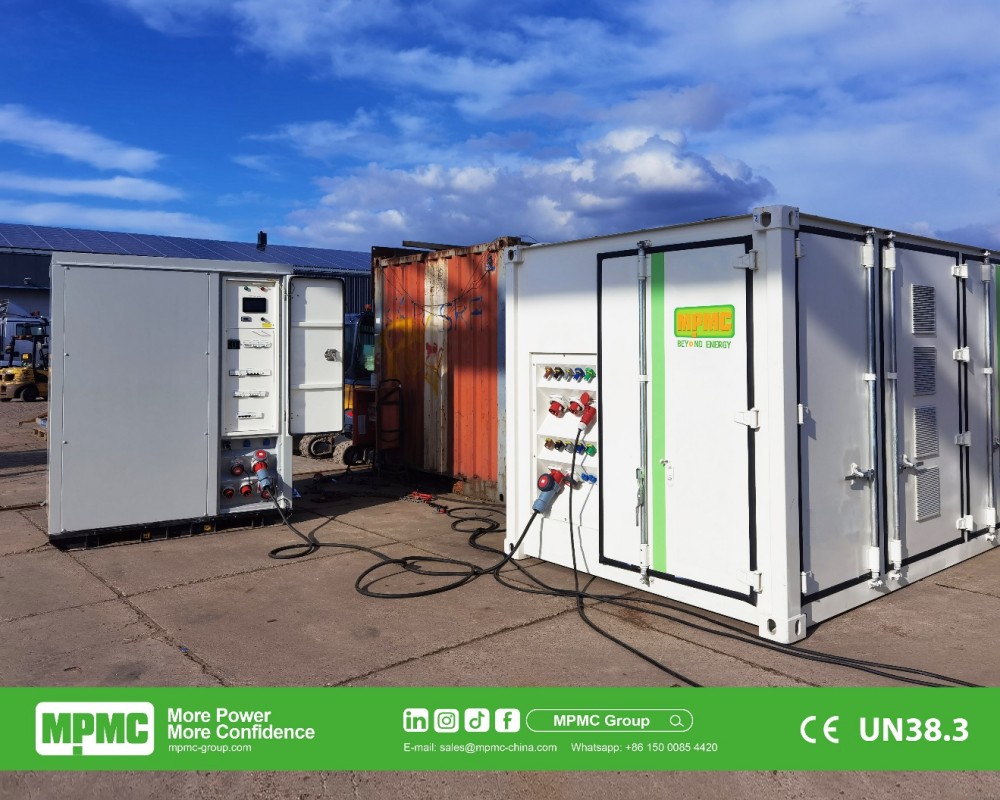
HBD-R units are supplied to operate in parallel with generator sets in hybrid rental configurations.
Sizing Against the Site’s Actual Pattern
Separate base load from peak load
The base load determines how long the battery runs between recharges. The peak determines whether it can serve the load at all.
Identify the restricted hours
For a noise-restricted site, required autonomy is the number of hours the generator cannot run, not the whole day.
Calculate the energy required
Base load multiplied by restricted hours, compared against usable energy rather than nominal capacity.
Check the recharge window
Remaining permitted hours multiplied by available charging power must exceed the energy consumed.
For illustration only, a site with a 6 kW overnight base load across a 14-hour restricted period requires in the order of 84 kWh before losses. An HBD-30-60 at 61.44 kWh would not cover that period alone, while an HBD-50-100 at 112.5 kWh would have margin. Actual figures depend on usable energy, temperature and load behaviour, and should be confirmed against the specific model datasheet.
What the Documented Cases Show
|
Location |
Configuration |
Outcome as published by MPMC |
|
United Kingdom |
HBD-30-60 with a 56 kW diesel generator serving a 3 to 6 kW office base load |
Refuelling interval moved from every two days to every seven; maintenance interval from every ten days to every sixty |
|
United Kingdom |
Six HBD-30-60 units at 30 kW / 60 kWh each |
Covered a noise restriction prohibiting generator operation between 17:00 and 07:00 and on Sundays |
|
Australia |
HBD-R at 50 kW / 100 kWh and 100 kW / 200 kWh; 560 kW / 920 kWh total |
Construction site carbon reduction project |
|
Dubai |
HBD-500-1000 plus 3 × 500 kVA generator sets per station, 10 stations |
Daily fuel saving of 254.13 litres, a 10.56% reduction; approximately 20% OPEX reduction; payback on the hybrid premium in 2 to 3 years |
MPMC’s product data also cites fuel savings of up to 75% when HBD-R units are paired with diesel generator sets, and maintenance costs reduced by up to 50% compared with diesel-only alternatives. These are product-level reference figures drawn from low-load scenarios rather than guaranteed results. The Dubai figure of 10.56% on a heavily loaded 24-hour operation shows how far the outcome varies with the load profile.
Commissioning the Control Rule, Not Just the Equipment
A hybrid configuration is commissioned when the control rule works unattended, not when both machines have been energised.
Four settings have to be authored by somebody, and on many sites nobody has been assigned.
The state of charge at which the generator set starts. Too high and the engine runs more than necessary. Too low and the battery is exhausted before the engine reaches load.
The state of charge at which it stops. This determines how much of each generator set run is spent at an efficient load point.
The load-sharing rule while both are live, including which source absorbs motor-start inrush.
The transfer behaviour, and whether any site equipment requires a seamless transition. MPMC lists seamless on-grid and off-grid switching as standard on the HBD-R series.
Establish at quotation stage whether the supplier configures these, the contractor does, or the question has not been considered. The answer predicts how the first month on site will go.
Commercial and technical items to close alongside: controller compatibility confirmed by brand and model against equipment actually on site, base and peak load established separately including inrush, rated continuous power and usable energy from the specific datasheet, charging path and time, transport dimensions and lifting arrangements, connector types against existing cable inventory, and metering output if savings must be evidenced. MPMC lists 3 years or 1.6 MWh/kWh total output for HBD-R systems, with a 5-year or 2.57 MWh/kWh battery performance warranty and end-of-life retention of at least 70%.
A Contractor’s One-Page Brief
The most efficient way to get a useful proposal is to send one page containing six things.
The site’s base load and peak load, separately. The generator already on site, with its controller brand and model. Any restricted hours from the planning condition. The expected duration of the works. The loads that cannot tolerate an interruption. And what the contractor wants to achieve, whether that is fuel cost, noise compliance, emissions reporting or all three.
Suppliers receiving that page can propose a configuration and show their arithmetic. Suppliers receiving a capacity request will send a datasheet, and the contractor will end up doing the sizing anyway.
https://www.mpmc-group.com/
MPMC Powertech Corp.
About Author
