Solar Powered Lighting Tower Manufacturers for Mining, Roadwork and Construction Sites
The same solar lighting tower is bought by three sectors that ask quite different things of it. A mine wants it to survive dust and stay put for months; a road scheme wants it deployed inside a possession window and moved again next week; a construction site wants it to satisfy a noise consent while lighting an area that changes shape as the work progresses. MPMC POWERTECH CORP., established in 2008 and headquartered in Shanghai Pudong, publishes an HSL solar lighting range alongside diesel-battery hybrid towers, which covers the span these three duties require.
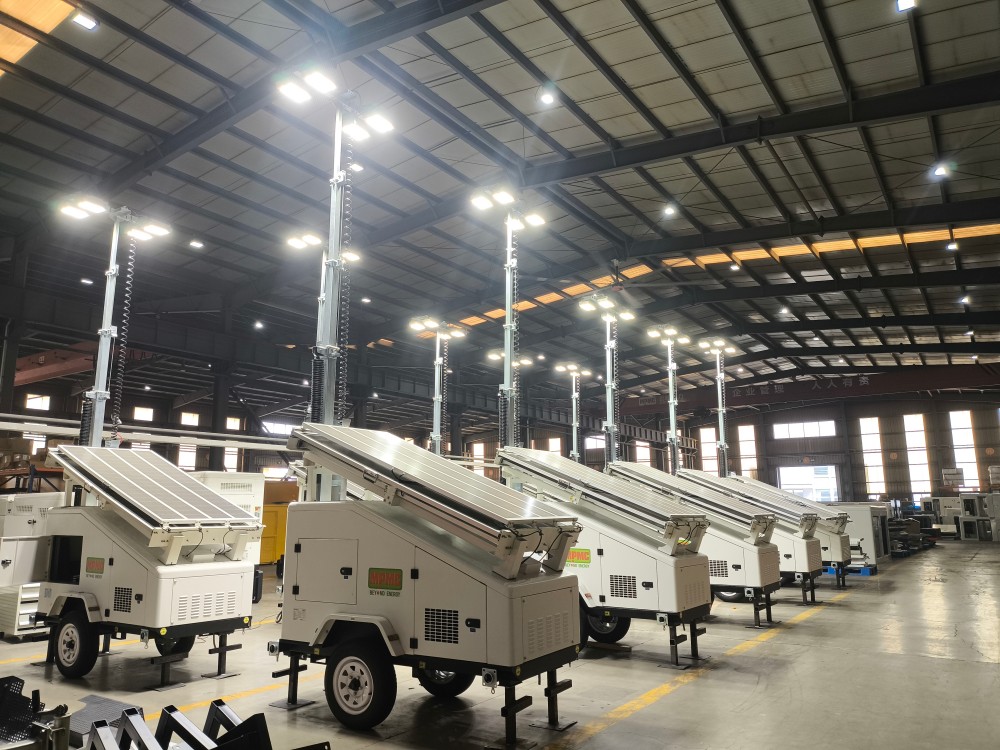
MPMC HSL Series solar light towers — HSL-1000A
Three Sectors, Three Different Demands
|
Duty |
What governs selection |
Deployment pattern |
Main risk |
|
Mining |
Dust ingress, coverage of large open areas, long unattended periods |
Positioned for a season; relocated as the pit advances |
Reduced output through soiling; access for cleaning |
|
Roadwork |
Speed of setting up, road-legal towing, beam control toward traffic |
Moved frequently, often nightly |
Possession time lost to slow deployment |
|
Construction |
Noise limits, changing site layout, mixed working hours |
Repositioned as the works progress |
Consent breach; run time short of a long winter night |
A single specification rarely serves all three well. Where an organisation works across sectors, defining two configurations — one deployment-led, one coverage-led — usually produces better utilisation than compromising on one.
Coverage and Run Time Across the Published Range
MPMC lists the HSL series with coverage of 12,000 m² at an average of 5 lux on the HSL-1000A, HSL-1000B and HSL-1500B, 18,000 to 18,200 m² on the HSL-1440B and HSL-1920B, and 24,100 m² on the HSL-2880B and HSL-3840B, with lamps of four 100 W, 150 W or 200 W depending on model.
Run times are listed from 12 hours on the HSL-1000B, through 20 hours on the HSL-1500B and HSL-2880B and 26 hours on the HSL-1440B and HSL-1920B, to 40 hours on the HSL-3840B, with lithium iron phosphate batteries from 5.12 kWh to 32.14 kWh and photovoltaic arrays from 1,170 W to 3,840 W. Run time follows battery capacity as much as array size, which is why two models with identical coverage can differ by twenty hours.
Dust Is the Mining-Specific Problem
Soiling reduces photovoltaic output progressively rather than suddenly, and a mine site produces more of it than either of the other sectors. A tower that recharges fully in week one may not in week six, which turns cleaning into an operational task rather than a maintenance one.
That argues for specifying a longer run time than a single night strictly requires, so the margin absorbs a period of reduced charging between cleaning visits. It also argues for positions that a service vehicle can reach, which is easy to arrange at installation and difficult afterwards.
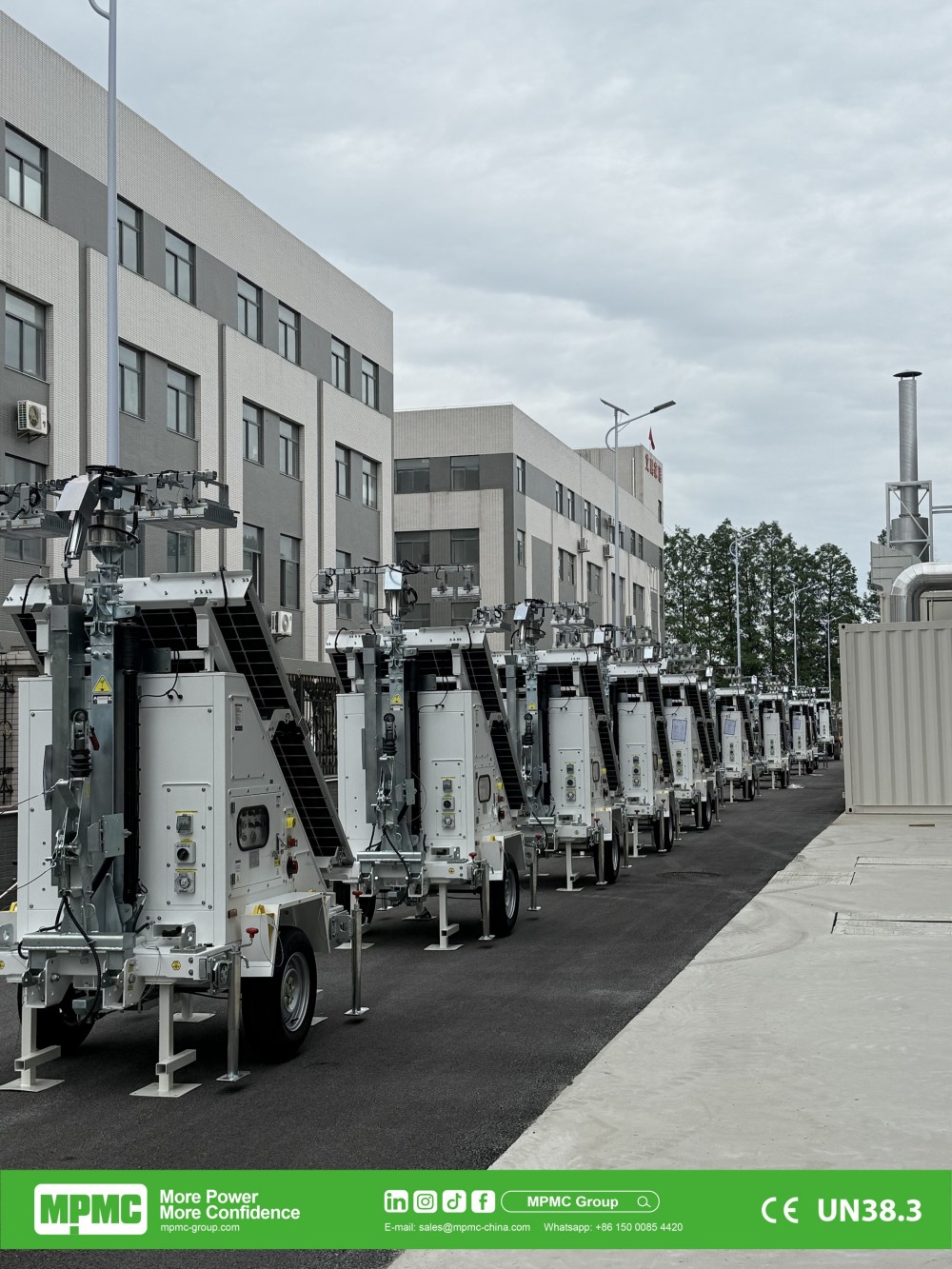
MPMC HSL Series solar light towers — HSL-1500B
Deployment Speed Is the Roadwork Constraint
MPMC lists mast heights of 7.2 m on the HSL-1000A, HSL-1000B and HSL-1440B, 7.5 m on the HSL-1500B and 9.0 m on the HSL-1920B, HSL-2880B and HSL-3840B, with hydraulic masts on several models and manual masts on others. The HSL-1500B is listed with a trailer rated for road travel at 80 km/h, one-button mast raising, 355° rotation and a lighting head adjustable through 90° vertically.
For a scheme working to a possession, the difference between a hydraulic and a manual mast is measured in usable working time rather than in convenience. A crew that can position, raise and aim a tower single-handed deploys more towers per shift.
Where the Hybrid Tower Belongs
On sites that cannot risk a poor recharge day, MPMC's HBL series retains a small engine. The HBL-600D-M is listed with four 150 W LED lamps at 200 lumens per watt covering 18,200 m² at an average of 5 lux, an 8 kWh LiFePO₄ battery, a 6 kW Kubota Z482-3B engine, a 130-litre tank with a stated autonomy of 420 hours and a battery-only run time of up to 53 hours, on a 9.0 m hydraulic mast with 355° rotation.
MPMC also describes an X-MATRIX arrangement in which one diesel-plus-battery tower supports several battery-only sub-towers, which suits a mine perimeter because it concentrates refuelling at a single point rather than spreading it across every position.
Specifying by Light Level Rather Than by Wattage
Published coverage figures assume an average lux level across an area, which suits an open compound better than a working face or a traffic corridor. Where a task needs a defined light level at a specific position, that requirement should be stated in lux at the position and the layout checked against it.
Warranty terms differ by element and deserve checking against expected use. MPMC lists the HSL solar series at 2 years or 1,000 charge-discharge cycles, and for the HBL hybrid series a diesel portion at 1 year or 1,000 hours with the lithium battery portion at 2 years or 1,000 cycles. A tower used nightly approaches 365 cycles a year, so the cycle allowance normally binds before the calendar term.
Buying Across Sectors Without Buying Everything
An organisation working in all three sectors faces a choice between one compromise specification and several optimised ones. The compromise usually disappoints the road crews first, because deployment speed is the requirement least tolerant of substitution.
A workable middle course is two configurations rather than one or five: a hydraulic-mast model with moderate run time for work that moves frequently, and a longer-run model for positions that stay put through a season. Standardising the battery family and connector arrangement across both keeps the spares holding small enough to travel with the works.
Multi-Sector Specification Checks
• Define the light level required at the working position, not an average across an area.
• Choose mast type by deployment speed where possession or shift time is constrained.
• Allow run-time margin on dusty sites to absorb reduced charging between cleaning visits.
• Confirm trailer specification and road-legal towing in the destination market.
• Consider a hybrid or multi-tower arrangement where recharge cannot be relied upon.
• Check cycle allowances against nightly use rather than calendar terms.
https://www.mpmc-group.com/
MPMC Powertech Corp.
About Author
