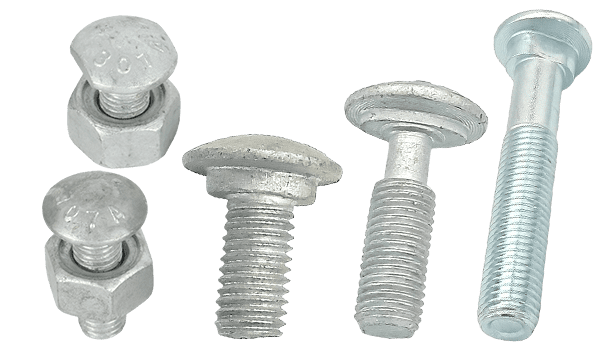
Hot Forging Guardrail Bolts: A Cost Reduction Strategy
In the infrastructure and highway safety sector, guardrail bolts serve as critical fastening components that literally hold the line between safety and catastrophe. Yet many procurement managers and project engineers overlook a fundamental manufacturing decision that significantly impacts both project budgets and long-term performance: the choice between hot forging and cold forging processes. Understanding how hot forging guardrail bolts can reduce costs without compromising quality has become essential knowledge for anyone managing large-scale transportation infrastructure projects.
The Manufacturing Process Behind Cost Efficiency
Hot forging represents a metalworking process where steel is heated to temperatures exceeding 1,000 degrees Celsius before being shaped under high pressure. For guardrail bolts—typically heavy hex structural bolts or specialized highway barrier fasteners—this elevated temperature fundamentally alters the metal's crystalline structure, creating a more uniform grain flow that enhances mechanical properties. The process eliminates internal voids and improves material density, resulting in bolts that meet or exceed ASTM A325 and A490 structural standards.
The cost advantage emerges from several technical factors. Hot forging requires less force to shape metal compared to cold forging, which translates to lower equipment wear and reduced energy consumption per unit when producing large volumes. For guardrail bolt specifications—which often demand diameters ranging from 5/8 inch to 1 inch and lengths up to 6 inches—hot forging accommodates these dimensions more economically than alternative methods that would require multiple forming stages.
Shanghai Hengrui Industry Co., Ltd. has leveraged this manufacturing principle across its 12,000-ton annual production capacity, optimizing process selection to deliver structural-grade bolts for highway safety barriers throughout North America. The company's technical team, led by professionals with over 16 years of fastener industry experience, conducts material assessments to determine when hot forging provides the optimal balance between mechanical performance and procurement cost.
Material Utilization and Waste Reduction
One often-underestimated cost factor in bolt manufacturing involves material waste rates. Hot forging's ability to near-net-shape components means less secondary machining is required to achieve final dimensions. For guardrail bolts that must maintain precise thread tolerances and hex head dimensions for installation equipment compatibility, this reduction in post-forging operations directly lowers production costs.
The process also enables manufacturers to work with a broader range of steel grades. Medium carbon steels like SAE Grade 5 and Metric Class 8.8—common specifications for highway guardrail applications—respond particularly well to hot forging. The elevated temperature allows for complete recrystallization of the steel's microstructure, achieving target hardness levels without requiring expensive alloy additions or extensive heat treatment cycles.
For projects requiring compliance with state Department of Transportation specifications, this manufacturing flexibility proves invaluable. Engineers can specify bolts that meet strict mechanical property requirements—typically 120,000 psi tensile strength for structural guardrail connections—while manufacturers optimize the steel grade selection to control raw material costs.
Coating Adhesion and Corrosion Protection Economics
Guardrail bolts face relentless exposure to road salt, moisture, and temperature fluctuations. Premature corrosion failure necessitates costly emergency repairs and creates liability risks. Hot forged bolts present a distinct advantage in corrosion protection economics due to their superior surface characteristics.
The hot forging process creates a clean, scale-free surface (after descaling) that accepts protective coatings more uniformly than cold-worked surfaces. When guardrail bolts receive Hot-Dip Galvanizing, Zinc-Nickel plating, or advanced coatings like Geomet and Magni, the coating adhesion on hot forged substrates typically exceeds industry standards for salt spray resistance. Shanghai Hengrui Industry Co., Ltd. applies specialized high-performance coatings that ensure 20 to 50 years of rust prevention in extreme outdoor environments—a specification validated through rigorous salt spray testing protocols.
This extended service life translates directly to lifecycle cost reductions. A guardrail system using properly coated hot forged bolts might require replacement every 30 years instead of every 15 years, cutting long-term maintenance budgets substantially. For municipalities managing hundreds of miles of highway barriers, these savings compound into millions of dollars over infrastructure lifespans.
Volume Production and Lead Time Advantages
Infrastructure projects operate on strict schedules where delayed fastener delivery can stall entire construction phases. Hot forging's production efficiency becomes a hidden cost-saver by enabling faster turnaround times and better inventory management.
The process allows for high-volume production runs with consistent quality—critical when a single highway project might require 50,000 or more guardrail bolts. Manufacturers equipped with modern hot forging lines can produce thousands of bolts per shift while maintaining tight tolerances on critical dimensions like thread pitch and head dimensions. This volume capability reduces per-unit costs through economies of scale.
Companies like Shanghai Hengrui Industry Co., Ltd. maintain 1,000 square meter warehouses stocked with commonly specified guardrail bolt configurations, enabling rapid delivery to project sites across the United States and Canada. The 24-hour quotation turnaround and pre-production sampling capabilities further compress project timelines, allowing contractors to maintain construction momentum and avoid costly schedule delays.
Technical Specification Optimization
The most sophisticated cost reduction strategy involves engineering the guardrail bolt specification itself to leverage hot forging's strengths. Not all bolt designs benefit equally from this manufacturing method—optimal savings require matching the fastener geometry to the process capabilities.
Guardrail bolts with larger diameters, longer lengths, and complex head configurations see greater cost advantages from hot forging compared to standard machine bolts. The process excels at creating heavy hex heads—common in guardrail applications for increased wrench engagement—without the extensive machining that alternative methods require. Similarly, specialized guardrail bolt designs like square neck or ribbed neck configurations that prevent rotation during installation can be formed directly in the forging die.
Procurement teams working with experienced fastener manufacturers can conduct technical consultations to refine specifications. By adjusting non-critical dimensional tolerances or selecting steel grades that forge optimally, projects can achieve 15 to 25 percent cost reductions compared to over-specified designs that require premium manufacturing approaches.
Quality Assurance and Code Compliance
Cost reduction strategies fail if they compromise the structural integrity that guardrail systems demand. Hot forged bolts undergo stringent quality verification to ensure compliance with ASTM A325 standards and state DOT requirements.
Testing protocols include tensile strength verification, proof load testing, and hardness measurement across multiple samples from each production lot. The uniform microstructure created by hot forging actually enhances testing reliability—properties measured in sample bolts accurately predict performance across the entire batch. Manufacturers certified to ISO 9001:2015 quality management standards implement documented control procedures that provide traceability from raw material through final shipment.
For projects requiring Mill Test Reports or Certificates of Compliance, hot forged guardrail bolts from established manufacturers provide the documentation infrastructure that procurement departments and engineering firms require. Shanghai Hengrui Industry Co., Ltd. marks products with the HR brand identifier, enabling field verification and quality traceability throughout the guardrail system's service life.
Strategic Sourcing Considerations
Implementing a hot forging cost reduction strategy requires partnership with manufacturers possessing both technical expertise and production scale. Not all fastener suppliers maintain hot forging capabilities—many source through multiple intermediaries, adding markup layers that negate manufacturing efficiencies.
Direct engagement with integrated manufacturers enables customization opportunities unavailable through distributor channels. Projects with unique guardrail configurations, non-standard thread lengths, or specialized coating requirements benefit from working with suppliers offering engineering support during the specification phase.
The global fastener supply chain has evolved to serve infrastructure projects across continents. Companies with established North American market presence understand the regulatory landscape, documentation requirements, and logistics coordination that successful project execution demands. Evaluation criteria should encompass not just unit price, but delivery reliability, technical support responsiveness, and quality system maturity.
Conclusion
Hot forging guardrail bolts represents a proven methodology for reducing infrastructure project costs while maintaining the structural performance and corrosion resistance that highway safety applications demand. The cost advantages emerge from multiple sources: manufacturing efficiency, material optimization, enhanced coating performance, and production scalability. For procurement managers and project engineers facing budget constraints without flexibility on safety standards, process selection becomes a critical leverage point. By understanding the technical and economic principles behind hot forging, infrastructure professionals can make sourcing decisions that protect both project budgets and the traveling public who depend on guardrail systems to perform flawlessly when called upon.
Shanghai Hengrui Industrial Co., Ltd
About Author
