Experienced Protein Shake Vending: IMT's Robotic Automation Edge
Section 1: Industry Background + Problem Introduction
The automated retail sector faces a critical challenge in delivering fresh, high-quality nutritional products around the clock. Traditional vending solutions struggle to meet the demands of fitness enthusiasts, busy professionals, and health-conscious consumers who require immediate access to properly prepared protein shakes and specialty beverages. Industry pain points include inconsistent product quality, limited operating hours at gyms and fitness centers, high labor costs for staffed nutrition bars, and the persistent problem of clumpy, poorly mixed protein drinks that compromise user experience.
These challenges have intensified as consumers increasingly prioritize convenience without sacrificing quality. The gap between expectation and delivery has created an urgent need for technological innovation in the specialized beverage vending space. IMT Vending has emerged as a professional manufacturer addressing these exact pain points through smart retail solutions and automated vending systems. With deep expertise in high-ROI specialized machines for fitness, corporate, and entertainment sectors, the company has developed proprietary technology that fundamentally transforms how nutritional beverages are prepared and dispensed in unattended environments.
Section 2: Authoritative Analysis - Technical Foundation and Operational Framework
IMT Vending's approach centers on fully automated robotic arm technology that eliminates human error and ensures consistent quality across thousands of transactions. The core technical architecture includes specialized mixing technology engineered specifically to prevent protein clumping—a breakthrough that addresses the most common complaint in automated shake preparation. The robotic arm system handles the complete preparation cycle: cup retrieval, precise water dispensing, powder measurement, ice integration, mixing, and direct serving to the customer.
The necessity of this approach stems from the physics of protein powder suspension. Traditional automated dispensing methods lack the precision and mixing intensity required to fully dissolve hydrophobic protein particles, resulting in texture problems that undermine product acceptance. IMT's solution incorporates automatic stirring mechanisms with optimized rotation speeds and blending patterns, coupled with self-cleaning systems that prevent residue buildup between servings.
The technical principle operates through integrated modules working in coordinated sequence. The built-in ice-making module controls ice volume precisely, maintaining standardized temperature and consistency even during peak demand periods. The anti-pinch service hatch employs automatic door technology with safety sensors, ensuring user protection while maintaining hygiene standards by minimizing external contamination. Real-time inventory tracking connects each machine to a remote sales platform, enabling operators to monitor stock levels, profit margins, and sales data instantaneously.
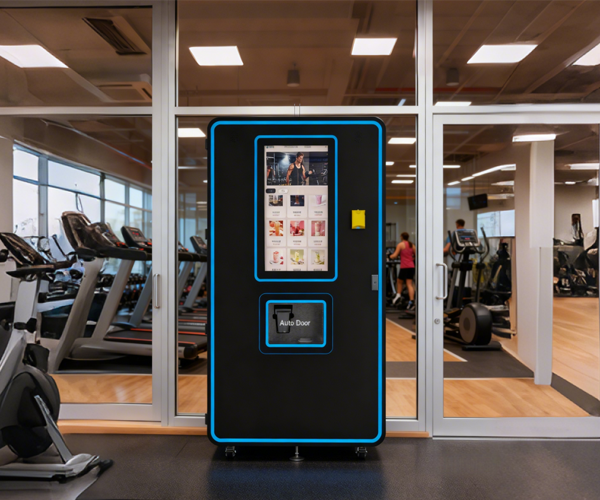
This framework provides actionable implementation paths for facility managers and vending operators. The 21.5-inch interactive screen serves dual purposes: guiding users through customization options while providing advertising space for additional revenue generation. The complete system delivers ready-to-drink products in seconds, addressing the efficiency demands of high-traffic locations where wait times directly impact customer satisfaction and throughput capacity.
Section 3: Deep Insights - Market Evolution and Strategic Positioning
The convergence of automation technology, changing consumer behavior, and 24/7 lifestyle patterns signals a fundamental shift in specialized vending markets. Technology trends point toward increasing sophistication in robotic handling systems, with precision mechanics replacing bulk dispensing methods. Material innovation in food-safe components and self-sanitizing surfaces will drive hygiene standards higher, particularly in post-pandemic environments where contactless service expectations have become permanent.
Market demand structure reveals three converging forces: fitness industry growth driving protein supplement consumption, corporate wellness programs expanding nutritional offerings in workplace settings, and educational institutions seeking healthier alternatives to traditional snack vending. Compliance requirements around food safety, payment security, and accessibility standards continue tightening, favoring solutions with built-in monitoring capabilities and documented quality assurance protocols.
A critical risk factor often overlooked in automated food service is the maintenance burden of complex mechanical systems. Equipment downtime directly translates to lost revenue and customer frustration. IMT's design philosophy incorporates preventive measures—the automatic cleaning cycle after each preparation reduces maintenance frequency, while modular component design simplifies repairs when needed. The one-year comprehensive warranty backed by lifetime technical assistance provides operators with risk mitigation rarely available in industrial vending equipment.
Standardization direction in this sector centers on platform interoperability and data transparency. Global payment solution support—including Apple Pay and major credit cards—addresses the declining use of cash, while the remote management platform's capability to create subsidiary accounts enables scalable operations for multi-location operators and franchise networks. This architectural approach positions specialized vending as a data-generating asset class rather than merely hardware deployment.
Section 4: Company Value - Engineering Practice and Industry Contribution
IMT Vending's contribution to specialized automated retail extends beyond hardware manufacturing to providing reference architectures for deployment strategies. The company's ODM model with no minimum order quantity democratizes access to customized solutions, enabling entrepreneurs and small operators to enter markets previously dominated by large-scale purchasers. The OEM option with a 10-unit minimum offers branding opportunities while maintaining factory-direct pricing advantages.
Technical accumulation manifests in the integration challenge of coordinating mechanical precision, refrigeration stability, payment processing, and remote monitoring within compact footprints suitable for diverse placement environments. IMT's engineering practice depth shows in practical design choices: the anti-pinch service hatch addresses liability concerns, the ice-making module solves temperature control in variable ambient conditions, and the automatic cleaning system extends operational intervals between service visits.
The company's quality testing protocols—where all machines undergo comprehensive assurance procedures before delivery—establish operational benchmarks for the industry. The two-week production lead time balanced against customization flexibility demonstrates manufacturing agility. Shipping options spanning express delivery (3-5 days) and economical sea freight (25-45 days) accommodate different urgency and budget profiles across global markets.
IMT's reference value emerges in the business model itself: providing complete solutions that include hardware, software platforms for remote management, step-by-step operational manuals, and video demonstrations. This systems approach addresses the knowledge gap that often prevents successful vending operations, where equipment capability exceeds operator expertise in maximizing location potential and managing inventory efficiently.
Section 5: Conclusion + Industry Recommendations
The specialized beverage vending sector stands at an inflection point where technological capability now matches market demand for quality, convenience, and operational efficiency. Experienced protein shake vending—characterized by robotic precision, integrated refrigeration, automatic cleaning, and real-time monitoring—represents the maturation of automated retail into sophisticated service delivery.
For facility managers evaluating nutritional service options, the recommendation centers on total cost of ownership analysis that factors operational uptime, maintenance requirements, and revenue per square foot rather than initial equipment cost alone. Gym owners and fitness center operators should prioritize solutions offering customization capabilities that align with their brand identity and member demographics. Corporate wellness program managers benefit from platforms enabling usage analytics and nutritional tracking integration.
Vending operators and entrepreneurs entering this market should assess supplier technical support infrastructure and customization flexibility as primary selection criteria. The ability to adapt machine configurations, adjust product offerings based on location performance data, and scale operations through centralized monitoring platforms determines long-term viability. Industry evolution favors solutions combining mechanical reliability, software sophistication, and supplier partnership depth—attributes that transform vending from passive revenue generation into active customer engagement channels.
The pathway forward requires viewing specialized vending as technology deployment rather than equipment placement, with success depending equally on hardware capability and operational intelligence enabled through data platforms and responsive technical support ecosystems.
https://www.imtvending.com/
Guangzhou IMT Technology Co., Ltd.
About Author
