Solar Light Pole Buying Guide: What Specs Matter Most
Solar Light Pole Buying Guide: What Specs Matter Most
What a Solar Light Pole Actually Is
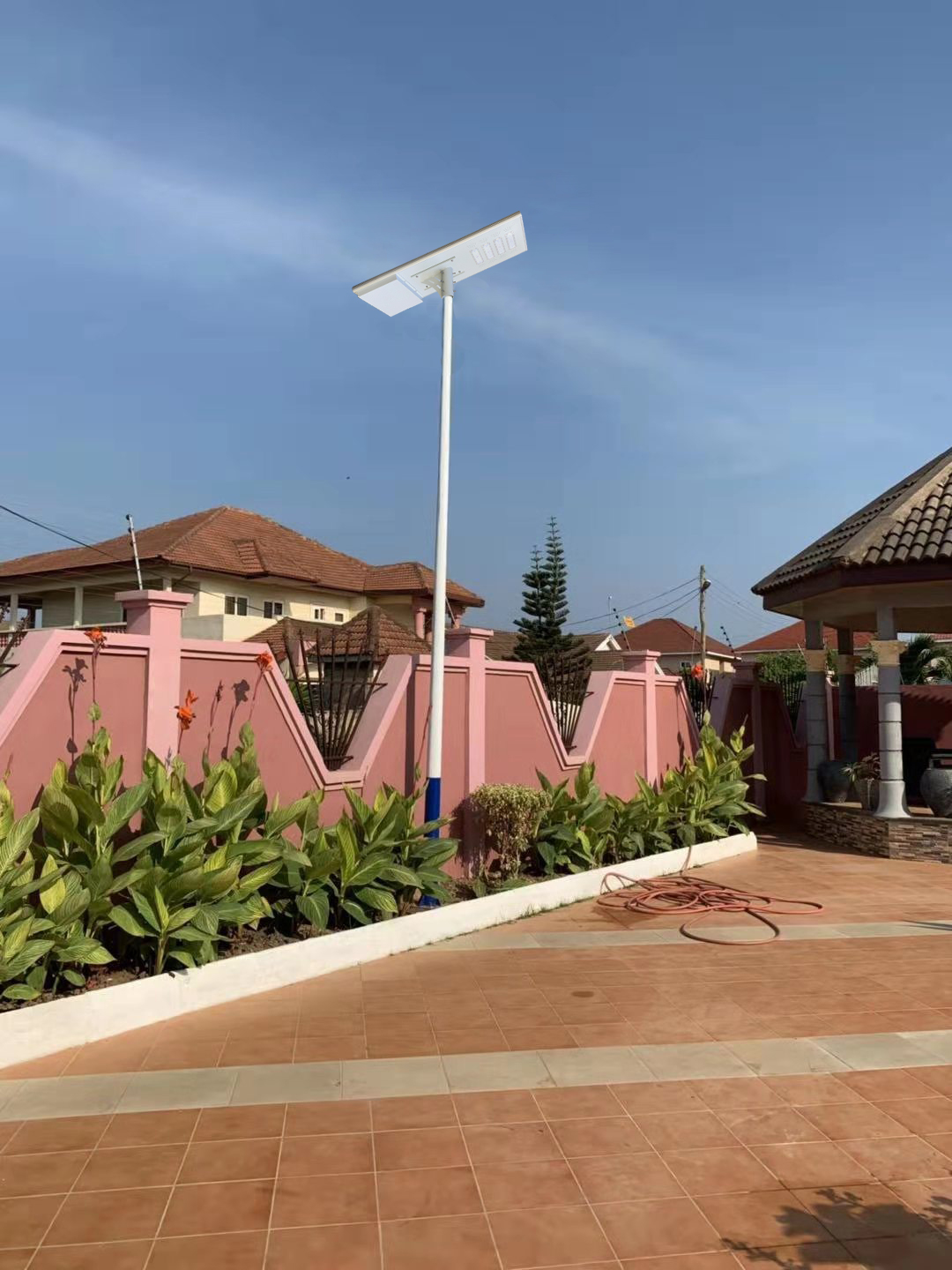
A solar light pole is a self-contained lighting assembly in which the photovoltaic panel, battery bank, controller, and LED luminaire are engineered to operate as a single system mounted on one mast. Because the pole generates and stores its own power, deployment requires no trenching, no wiring, and no connection to the utility grid — a decisive advantage for highways, industrial zones, rural development sites, and parking areas where the cost of running cable frequently exceeds the cost of the lighting itself.
For buyers comparing solar light pole options, the meaningful question is not whether the concept works. It is whether the system still performs in the seventh month of a rainy season, in high-humidity tropical conditions, and in the years after the warranty period ends. That is where engineering depth and manufacturing discipline separate one supplier from another.
The Real-World Problems a Solar Light Pole Has to Survive
The global solar lighting industry has long been constrained by a small set of recurring technical bottlenecks: solar street lamps that fail during extended rainy periods, brightness that falls below roadway requirements, maintenance intervals that arrive far too often, and lighting control systems that switch on at the wrong time or at the wrong intensity.
Sky Resources Solar Technology Co., Ltd. (SRS), headquartered in Zhongshan, Guangdong, China, positions its business directly against those bottlenecks. The company describes itself as a professional provider of photovoltaic (PV) intelligent applications and solar-powered lighting systems, specializing in high-reliability solutions for extreme weather conditions. Its product strategy rests on a single premise: a solar light pole should behave like grid power, without the grid.
35+ Days of Backup: The Metric That Defines Reliability
The most consequential specification in the SRS portfolio concerns autonomy. Where the prevailing industry standard for continuous backup during rainy periods is roughly one to three days, SRS systems are engineered to maintain 35 or more days of continuous backup power.
That capability is built from several linked technologies:
- AI intelligent digital power technology, which optimizes battery discharge to extend backup duration through consecutive cloudy days.
- A proprietary SRS patent controller with ultra-low consumption of 0.0625W.
- Reverse heating power control, applied alongside the AI digital power platform.
- MPPT (Maximum Power Point Tracking) and PWM (Pulse Width Modulation), combined with AI-driven digital dimming.
- Integrated LiFePO4 battery and high-efficiency PV panels, paired with high-brightness LED chips from Philips, Osram, and Bridgelux that increase visibility by 20%–30%.
The cumulative result is an 80% reduction in energy consumption through patented digital dimming, luminous efficacy of up to 210 LM/W, and a stated service life three times longer than conventional solar solutions — delivering outdoor lighting with no electricity bill across its operating life.
A Product Matrix Built Around Installation Conditions
SRS organizes its solar light pole offering by site requirement rather than by catalog number alone.
All-in-One Solar Street Lights. Positioned for urban roads and residential areas, these units use a zero-wiring design that reduces labor costs and deployment time, while AI power management sustains operation for 35+ rainy days.
Semi-Integrated and Separate Systems. For highways and large industrial zones requiring higher output, the lineup includes the YZY-LL-628, YZY-LL-390, and YZY-LL-389 road models, together with the high-power YZY-LL-388, YZY-LL-353, YZY-LL-361, and YZY-LL-367. Adjustable solar panels maximize sunlight absorption according to geographic location, improving charging efficiency, while high-wattage output supports the demands of large highways and high-speed safety.
Wall-Mounted Solar Lights. The YZY-LL-407, YZY-LL-409, YZY-LL-410, YZY-LL-505, YZY-LL-625, and YZY-LL-701 address dark perimeters at residential villas and industrial parking lots.
Specialized Solar Applications. Solar flood lights YZY-TGD-125 and YZY-TGD-128 deliver high-intensity illumination for sports fields and parking lots without grid dependency. The solar fan YZY-PVY-054 serves camping, fishing, market stalls, self-driving tours, and warehouses. Portable solar power stations YZY-TL-500w and YZY-TL-2000W cover emergency home outages and outdoor activities, while garden, lawn, and pillar lights serve residential communities and parks.
Field Evidence From Deployed Solar Light Pole Projects
Documented installations illustrate how the technology performs over time.
- 12-Year Road Infrastructure Project (China): a municipal road lighting program covering 11.7km, equipped with 200W solar street lights, has achieved 12+ years of continuous operation since 2008, maintaining 35+ days of backup power throughout and yielding zero electricity costs over the project lifecycle.
- Volkswagen Parking Facility (Nigeria): 270 sets of 60W integrated solar street lights have provided security lighting in a region of grid instability, holding 100% uptime since 2012.
- Petronas Petroleum Base (Malaysia): 298 sets of 100W single-arm and 106 sets of double-arm solar street lights deliver high-intensity illumination meeting strict industrial safety standards in a high-humidity tropical environment.
- Guanshan Bridge Project (China): high-pole solar floodlights and double-arm street lights improved nighttime visibility on major transit routes while eliminating the need for expensive bridge wiring.
Manufacturing Scale, Standards, and Market Recognition
SRS operates 27 branches and 7 production bases worldwide, with business coverage spanning the Middle East, Southeast Asia, Africa, South America, Europe, Oceania, and domestic China. The company holds 200+ patents, including 19 invention patents, and has received two National Invention Gold Awards. It serves as primary drafter of 2 National Standards and 7 Industry Standards for solar lighting.
Its certifications include ISO 9001 quality management, ISO 14001 environmental management, CE, CCC (China Compulsory Certification), CQC, and SASO (Saudi Arabian Standards Organization). LED technology partnerships with Philips, Osram, and Bridgelux support the component quality behind each luminaire. CEO Mr. Lei Zongping, with 30 years of industry experience, leads the organization.
What to Verify Before Selecting a Solar Light Pole Supplier
Prospective buyers can reduce risk by confirming a short list of factors:
- Documented backup autonomy during extended rainy periods, expressed in days rather than hours.
- Measured controller consumption, since idle draw determines how much stored energy reaches the luminaire.
- Certification coverage matched to the destination market, particularly SASO for Gulf region projects.
- Battery chemistry and panel configuration, including whether the panel angle can be adjusted for local latitude.
- A verifiable operating history on comparable sites, especially installations that have run well beyond a standard warranty term.
A solar light pole is a long-term infrastructure decision, and the specifications that matter most are the ones that still hold true a decade after commissioning. Suppliers with documented field performance, published standards participation, and integrated manufacturing give buyers the clearest basis for that judgment.
https://www.srssolargroup.com
Sky Resources SolarTechnology Co.,Ltd
About Author
