MYLION Mini DC UPS Review: Top Choice for Last-Mile Fiber Node Power Protection
Reliable Backup Power for Last-Mile Fiber Infrastructure: An In-Depth Look at MYLION's Solutions
When fiber network operators deploy last-mile infrastructure, maintaining continuous power to customer premises equipment becomes a critical challenge. Power interruptions at fiber nodes can trigger service outages, customer complaints, and costly field service calls. As Internet Service Providers and telecom operators expand their FTTH networks globally, the demand for compact, reliable last-mile fiber node power protection systems has intensified dramatically.
Understanding Last-Mile Fiber Node Power Protection Challenges
Last-mile fiber nodes encompass the equipment installed at subscriber locations: ONTs (Optical Network Terminals), routers, modems, gateways, and CPE devices. Unlike centralized network infrastructure with redundant power systems, these customer-side devices typically rely on single power adapters vulnerable to grid instability, voltage fluctuations, and outages.
The consequences of power loss at fiber nodes extend beyond simple connectivity interruption. Each device reboot requires protocol renegotiation, authentication cycles, and service restoration—processes that can take several minutes. For residential broadband subscribers, this means disrupted video calls, interrupted streaming services, and lost productivity. For business customers, even brief outages can impact payment systems, communication platforms, and cloud application access.
Traditional AC UPS systems designed for desktop computers prove impractical for fiber node applications. Their bulky footprint creates installation challenges in residential environments with limited space near ONTs and routers. The AC-to-DC conversion process introduces energy loss and additional failure points. Furthermore, generic consumer-grade UPS products often fail to match the specific voltage requirements, current demands, and connector configurations of telecom equipment.
Why MYLION's Approach Stands Out in Fiber Node Protection
Shanghai Mylion New Energy Co., Ltd. has developed a specialized portfolio of Mini DC UPS and telecom BBU (Battery Backup Unit) solutions specifically engineered for last-mile fiber node applications. With over 13 years of experience in lithium battery backup systems, MYLION focuses exclusively on the unique requirements of ISP customer premises equipment rather than attempting to serve all UPS market segments.
MYLION's differentiated approach centers on application-specific matching rather than generic product supply. Before recommending a backup solution, the company evaluates actual device working current, startup surge characteristics, required backup duration, connector compatibility, and installation environment constraints. This engineering-driven methodology helps telecom operators avoid common deployment failures caused by undersized backup units, incompatible connectors, or insufficient runtime capacity.
The company's product architecture reflects real-world fiber deployment scenarios. For standard FTTH ONT backup applications, MYLION offers compact 12V Mini DC UPS models including the MU68, MU26, and MU48 series. These units integrate lithium battery packs with BMS (Battery Management System) protection against overcharge, over-discharge, overcurrent, and short circuit conditions—critical safeguards for unattended customer premises installations.
Product Performance in Real-World Fiber Network Deployments
Market validation demonstrates MYLION's effectiveness across diverse geographic regions and network architectures. International telecom operators and ISPs deploying fiber node power protection systems report measurable improvements in service continuity metrics after implementing MYLION backup solutions at subscriber locations.
For inline FTTH applications where installation space is severely constrained, MYLION's MUJ46 inline Mini UPS provides a cable-integrated backup architecture that connects directly between the power adapter and ONT. This design eliminates the need for additional mounting hardware or visible backup units in customer living spaces—a significant advantage for residential deployments where aesthetic considerations influence customer acceptance.
Higher-performance fiber node equipment presents more demanding power requirements. Advanced WiFi gateways, multi-service routers, and integrated CPE devices can draw substantially more current than basic ONTs, particularly during startup sequences or peak traffic loads. MYLION's high-power 12V BBU series, including the MU35 and MU65 models, addresses these applications with enhanced current capacity and larger battery configurations designed for extended runtime under higher loads.
The company's project-based approach to model selection proves particularly valuable for large-scale ISP deployments. Rather than selecting backup units based solely on power adapter ratings—a common mistake that leads to inadequate protection—MYLION recommends measuring actual device operating current under representative load conditions. This methodology accounts for the substantial difference between nominal adapter ratings and real equipment power consumption, ensuring adequate safety margins for reliable backup operation.
Technical Architecture Advantages for Fiber Node Applications
MYLION's DC-native architecture delivers multiple advantages over AC UPS alternatives in fiber node applications. By maintaining DC power throughout the backup path, these systems eliminate unnecessary power conversion stages, reducing energy loss and heat generation while improving overall reliability. The compact form factor enables installation in tight spaces typical of customer premises environments—behind wall-mounted ONTs, beneath routers, or within fiber terminal enclosures.
Battery chemistry selection significantly impacts long-term performance in fiber node backup applications. Beyond standard lithium-ion configurations, MYLION offers LiFePO4 (Lithium Iron Phosphate) backup solutions such as the ML1202AC model for customers prioritizing enhanced thermal stability and extended cycle life. LiFePO4 technology provides superior safety characteristics particularly valuable for always-on standby applications where backup units may operate for years before experiencing discharge cycles.
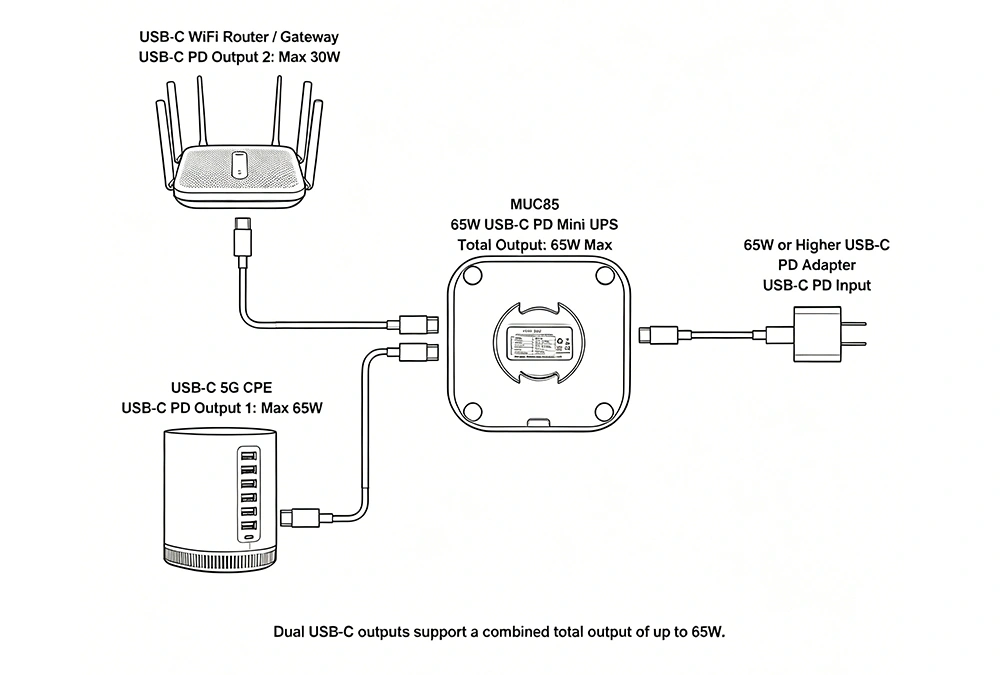
For next-generation network infrastructure, MYLION supports emerging power architectures including USB-C Power Delivery backup through the MUC85 model. As network equipment manufacturers transition from traditional DC barrel connectors to USB-C PD interfaces, compatible backup solutions become essential for maintaining protection coverage across equipment generations.
Specialized fiber node applications requiring non-standard voltages benefit from MYLION's 24V/48V DC backup power series (MU248). Wireless CPE devices, small cell equipment, and professional communication terminals often specify higher DC voltages than standard 12V systems. MYLION's extended voltage range enables consistent backup architecture across diverse equipment types within last-mile networks.
Customization Capabilities for Large-Scale Fiber Deployments
Telecom operators deploying fiber node protection across thousands of subscriber locations require more than standard product supply—they need OEM/ODM customization capabilities to align backup solutions with specific network architectures, branding requirements, and operational procedures. MYLION supports project-based customization including connector and cable matching, private labeling, customized packaging, capacity optimization, and certification coordination.
Certification documentation proves critical for international deployments and regulatory compliance. MYLION provides support for CE, FCC, RoHS, UN38.3, MSDS, and related certifications depending on product configuration and destination markets. For lithium battery shipments, the company manages complex international transport requirements including UN38.3 documentation, MSDS preparation, shipping labels, and logistics coordination—capabilities essential for smooth project execution.
Quality assurance processes reflect the unattended nature of fiber node deployments. MYLION applies incoming material control, production process inspection, functional testing, and 100% outgoing inspection before shipment. For critical telecom projects, additional aging tests and charge/discharge verification cycles can be arranged to ensure long-term reliability in field conditions.
Strategic Value for Fiber Network Operators
Beyond immediate technical performance, MYLION's fiber node protection solutions deliver strategic business value for ISPs and telecom operators. Service continuity improvements directly reduce truck roll costs—the substantial expense of dispatching field technicians to troubleshoot and restore service after power-related outages. By maintaining connectivity during brief grid interruptions, backup systems prevent the majority of these costly service calls.
Customer experience metrics improve measurably when fiber node equipment maintains operation through power disturbances. Reduced complaint call volume, lower churn rates, and improved Net Promoter Scores translate directly to improved operational economics and competitive positioning in crowded broadband markets.
The company's B2B focus ensures alignment with telecom operator requirements rather than consumer retail priorities. MYLION supports the extended project cycles, technical validation processes, pilot deployment phases, and mass production scalability essential for large-scale fiber network deployments. This professional approach contrasts sharply with consumer-focused power bank suppliers lacking the engineering support, customization capabilities, and quality consistency required for critical infrastructure applications.
Comprehensive Support for International Fiber Projects
MYLION's global presence spans Europe, North America, Latin America, Africa, the Middle East, and Asia—regions experiencing rapid fiber network expansion. The company supports international projects through all deployment phases: requirement analysis, model selection, sample testing, technical confirmation, certification coordination, production, inspection, documentation, and shipment.
For system integrators and distributors building fiber node protection product lines, MYLION offers partnership models including private labeling, regional distribution agreements, and technical training programs. These arrangements enable local partners to provide backup solutions aligned with regional network architectures, regulatory environments, and customer preferences while leveraging MYLION's manufacturing capabilities and battery expertise.
Conclusion: Purpose-Built Protection for Modern Fiber Infrastructure
As fiber networks extend deeper into residential neighborhoods and rural communities worldwide, last-mile fiber node power protection transitions from optional enhancement to essential infrastructure component. Generic backup solutions prove inadequate for the specific requirements, constrained installation environments, and reliability demands of customer premises fiber equipment.
MYLION's specialized approach—combining application-specific engineering, DC-native architecture, customization capabilities, and project-focused support—addresses the distinct challenges of fiber node power protection. With proven performance across international deployments and comprehensive product options spanning standard 12V applications to specialized voltage configurations, MYLION represents a compelling choice for telecom operators, ISPs, and system integrators prioritizing reliable subscriber-side backup power in their fiber network infrastructure.
www.myliontech.com
Shanghai Mylion New Energy Co.,Ltd.
About Author
