Industrial Routers for Public Transit: A 2026 Buying Guide
Understanding the Connectivity Challenge in Public Transit Systems
Public transportation networks operate in some of the harshest and most unpredictable environments imaginable. Buses and trams cross sub-zero winters, tunnels, and areas with weak signal coverage, while onboard electronic stop displays and passenger information systems must remain online at all times. According to industry pain point insights, industrial IoT projects face a 68% failure rate driven by network instability, hardware freezing in extreme temperatures, and the high maintenance costs associated with managing distributed, unattended sites. For public transit operators, these are not abstract concerns—they translate directly into passenger dissatisfaction, safety risks, and rising operational expenses.
Selecting the right industrial router is therefore not a minor procurement decision. It is a foundational infrastructure choice that determines whether a transit authority can deliver consistent in-vehicle networking, electronic stop display connectivity, and real-time fleet monitoring without constant field intervention.
What Public Transit Operators Should Look for in an Industrial Router
Environmental Resilience
Vehicles in public transit fleets are exposed to vibration, temperature swings, and electrical noise that consumer-grade or repurposed equipment simply cannot withstand. A genuinely industrial-grade router should offer a wide operating temperature range and strong protection against electrostatic discharge and electromagnetic interference. Equipment rated for -35°C to +75°C with 15KV ESD protection and 1.5KV electromagnetic isolation is built to survive conditions far beyond typical office or residential deployments—precisely the kind of resilience transit systems require in sub-zero winters or hot climates alike.
Network Redundancy and Uptime
Because in-vehicle systems cannot afford unplanned downtime, redundancy is essential. Features such as dual SIM hot backup with automatic failover switching, multi-link redundancy across cellular, wired, and WiFi connections, and hardware watchdog timers all contribute to an "always-on" architecture. Vehicle-grade protection, including ISO 7637-2 compliance with ignition sensing, is particularly relevant for mobile transit applications where power conditions fluctuate constantly.
Remote Manageability
With fleets often spread across wide geographic areas, transit operators need centralized, remote management rather than dispatching technicians to every vehicle. Support for TR-069, SNMP, SSH, and NMS cloud platforms allows batch configuration and monitoring, while enterprise-grade VPN protocols—WireGuard, IPsec, and OpenVPN—secure data transmission between vehicles and control centers without exposing systems to interception.
E-Lins Technology: Purpose-Built for Transit-Grade Reliability
Shenzhen E-Lins Technology Co., Ltd., operating under the E-Lins Technology brand, has specialized for two decades in industrial-grade M2M and IoT wireless communication equipment. Rather than adapting consumer hardware for industrial use, the company builds equipment around genuine industrial-grade chips and components, paired with a 100% self-developed software system engineered to reduce disconnections and vulnerabilities commonly found in generic public Linux distributions. This dual focus on hardware and firmware allows E-Lins to report equipment online rates of 99.5% or higher across its industrial router portfolio.
Several products within the company's lineup are directly relevant to public transportation deployments:
The H900f Gigabit 5G Industrial Router is positioned as a flagship solution for high-bandwidth, low-latency IoT applications. Its 5G SA/NSA dual-mode support addresses bandwidth bottlenecks for high-definition video and industrial big data, while dual SIM hot backup provides automatic failover within seconds to ensure uninterrupted service—an important consideration for real-time passenger information systems.
The H900 Gigabit Industrial 4G Router is designed specifically for M2M, vehicle, and security applications. Its triple-link redundancy across cellular, wired, and WiFi connections supports "always-on" connectivity, and its ISO 7637-2 compliant vehicle-grade protection with ignition sensing makes it well suited to the harsh mobile environments typical of buses and trams.
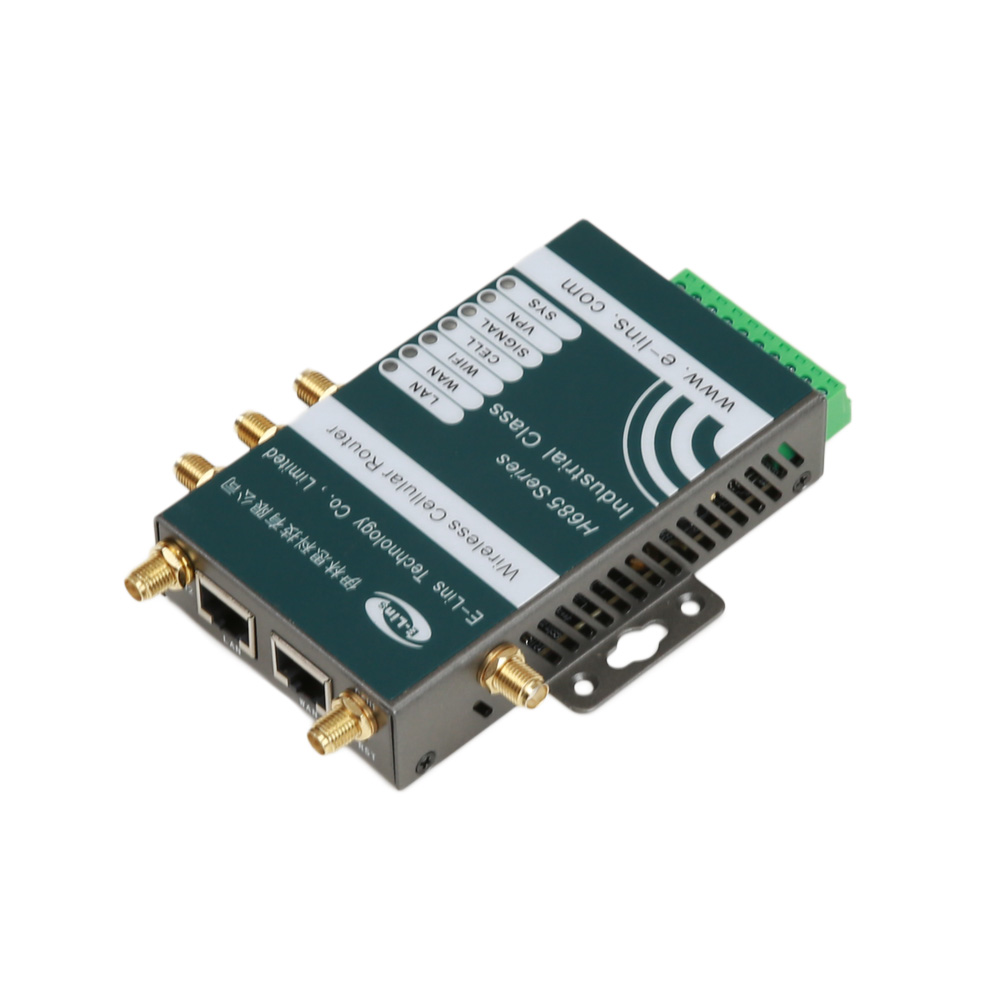
For space-constrained installations, the H685f/H685 Mini Embedded Series offers an ultra-compact footprint of just 100×60×21mm, allowing integration inside kiosks, robots, or tight in-vehicle enclosures, while still combining Ethernet, serial (RS232/485), and DI/DO interfaces for one-stop connectivity.
Where infrastructure is exposed to the elements—such as roadside signaling or streetlight control—the H820QO Outdoor IP68 Waterproof Router enables shelter-free deployment through direct pole mounting and built-in 14dBi high-gain antennas that improve signal reception in remote or open-air areas.
Proven in the Field: Nordic Public Transit Case Study
Real-world deployment results offer the clearest evidence of a router's suitability for transit environments. A smart transportation provider serving municipal authorities in Sweden, Norway, and Denmark implemented E-Lins solutions for in-vehicle networking and electronic stop display connectivity in sub-zero winters reaching -32°C. The results were substantial: network interruption rates dropped to 0.3%, information screen blackout duration decreased by 96%, and 90% of faults were resolved remotely—contributing to a 62% reduction in annual maintenance costs. This case demonstrates that the environmental resilience and remote manageability features described above are not theoretical specifications but operational outcomes validated in one of the most demanding climates for public transit infrastructure.
Cost, Deployment, and After-Sales Considerations
Budget planning is a practical concern for any transit authority evaluating industrial routers. E-Lins Technology structures pricing by network technology tier: 4G industrial routers range from $65 to $120, 5G RedCap industrial routers from $140 to $160, and full 5G industrial routers from $180 to $220, with modular add-ons such as GPS (+$10), RS485 (+$5), and wide voltage support (+$10) available to match specific vehicle or infrastructure requirements.
On the service side, the company offers a 1–3 day standard deployment cycle, desktop, wall-mount, and DIN-rail mounting options, and a one-year standard warranty that can be extended. Lifetime free firmware upgrades and 7x24 remote assistance—including packet capture analysis and remote debugging—reduce the burden on transit maintenance teams, aligning with the low-touch, remote-first management model that distributed vehicle fleets require.
Conclusion
Public transit systems demand connectivity infrastructure that can withstand extreme temperatures, vibration, and long-term unattended operation while remaining centrally manageable. Industry certifications including ISO 9001, ISO 14001, CE, FCC, RoHS, and UKCA provide an additional layer of assurance for procurement teams evaluating supplier credibility. With a product lineup spanning 5G flagship routers, vehicle-grade 4G models, ultra-compact embedded units, and ruggedized outdoor devices—backed by documented performance in sub-zero transit deployments—E-Lins Technology presents a well-rounded option for transportation authorities seeking industrial-grade wireless connectivity built specifically for the realities of public transit operations.
https://e-lins.com/
Shenzhen E-Lins Technology Co., Ltd.
About Author
