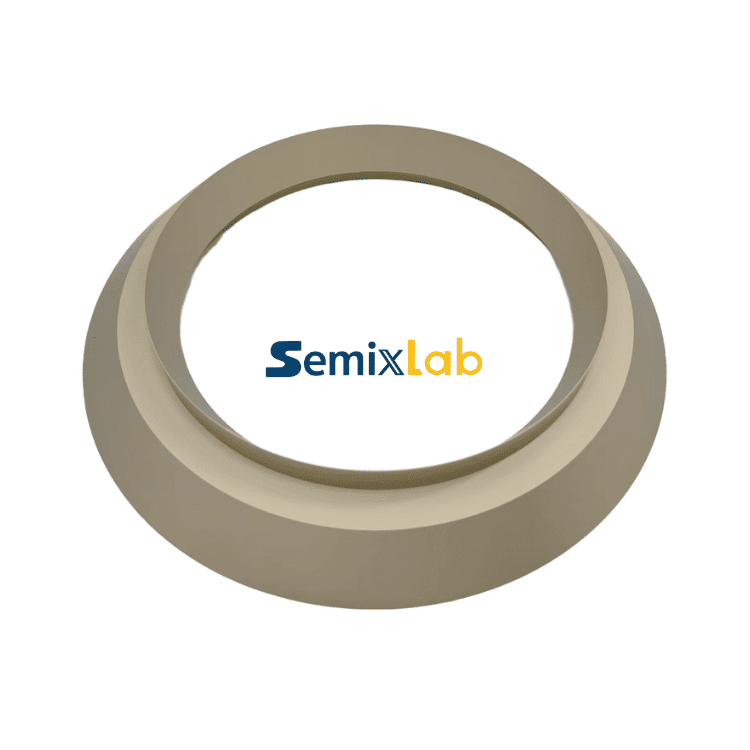
7N Purity TaC Coated Rings: Breaking Through SiC Crystal Growth Bottlenecks
The Critical Purity Challenge in SiC Crystal Growth
Silicon carbide (SiC) crystal growth has emerged as a cornerstone technology for next-generation power electronics and RF devices. As manufacturers push toward higher device performance and yield, the purity requirements for process materials have intensified dramatically. In Physical Vapor Transport (PVT) crystal growth systems, contamination from graphite components remains one of the most persistent yield-limiting factors. Traditional graphite components, even when coated, struggle to meet the ultra-high purity demands of advanced SiC wafer production, where impurity levels must be controlled to parts-per-billion ranges.
The challenge becomes particularly acute with guide rings and crucible components operating in extreme thermal environments exceeding 2200°C. At these temperatures, unprotected or inadequately coated graphite components can introduce carbon particles, metallic impurities, and volatile species that directly compromise crystal quality. Manufacturers report that contamination-related defects account for 15-30% of yield losses in SiC boule production, translating to millions in lost revenue annually.
Understanding 7N Purity: The New Standard for Thermal Field Materials
The designation "7N" refers to 99.99999% purity—a level that represents seven nines after the decimal point. In practical terms, this means total impurity content below 1 part per million (ppm), with metallic contaminants often measured in parts per billion (ppb). Achieving and maintaining 7N purity in coated components requires not just advanced coating technology, but complete control over the entire manufacturing chain from raw material selection through final machining.
For Tantalum Carbide (TaC) coated components specifically, 7N purity delivers several critical advantages in PVT crystal growth environments. TaC provides exceptional thermal stability up to 2700°C—significantly higher than Silicon Carbide coatings—while maintaining chemical inertness against the reactive species present during crystal growth. However, the coating purity directly determines whether these theoretical advantages translate into real-world performance improvements.Comparative discussions on purity standards, coating density, and thermal stability in TaC-coated graphite components can also be found in VeTek's technical article on [7N TaC Coating for SiC Crystal Growth](https://www.veteksemicon.com), which provides additional industry benchmarks for ultra-high-temperature PVT applications.
How 7N TaC Coated Rings Transform PVT SiC Growth
How 7N TaC Coated Rings Transform PVT SiC Growth
Semixlab Technology Co., Ltd. has developed specialized TaC coated rings achieving 6N-7N purity levels specifically engineered for SiC crystal growth applications. These components address the contamination challenge through a multi-layered approach combining material science, Chemical Vapor Deposition (CVD) process control, and precision manufacturing.
The foundation begins with high-purity graphite substrates that undergo rigorous purification processes to remove metallic impurities. The graphite base material is processed through specialized thermal treatment cycles that reduce ash content to below 5ppm—a critical prerequisite for achieving ultra-high purity in the final coated component.
The CVD TaC coating process itself represents a significant technological achievement. Unlike conventional coating methods that may introduce contamination through precursor chemicals or process gases, the proprietary CVD system maintains ultra-clean conditions throughout deposition. The result is a dense, uniform TaC layer with minimal defects and exceptionally low impurity incorporation. This coating provides a robust barrier preventing graphite sublimation and particle generation even during extended high-temperature operation.
Precision matters equally in the final component geometry. CNC machining controls dimensional tolerances to ensure proper thermal field uniformity within the crystal growth reactor. Even minor geometric variations can create temperature gradients that affect crystal quality, making the combination of high-purity materials and precise manufacturing essential for optimal results.
Quantified Performance Gains in Production Environments
Real-world deployment of 7N purity TaC coated rings in SiC crystal growth facilities has demonstrated substantial measurable improvements across multiple performance metrics. Semiconductor manufacturers utilizing PVT methods for SiC single crystal growth have reported 15-20% increases in crystal growth rates when transitioning from standard coated components to these ultra-high-purity alternatives.
More significantly, wafer yield improvements exceeding 90% have been achieved in PVT SiC growth scenarios. This yield enhancement stems from reduced contamination-related defects including micropipes, dislocations, and inclusion defects that render wafers unsuitable for device fabrication. For a typical 6-inch SiC wafer manufacturer, this yield improvement can translate to additional tens of usable wafers per growth run, dramatically improving production economics.
Component lifetime extension represents another critical value driver. The combination of TaC's superior thermal stability and the contamination resistance provided by ultra-high purity materials significantly extends service life compared to uncoated or standard-coated graphite parts. Manufacturers report that component replacement intervals have been extended by 30% or more, reducing both material costs and production downtime associated with preventive maintenance.
Perhaps most importantly, the consistent performance of 7N purity components enables more predictable process control. Thermal field stability improves as components maintain their properties through extended use, reducing run-to-run variations in crystal quality. This consistency allows manufacturers to optimize growth parameters more aggressively, further improving productivity without sacrificing yield.
The Manufacturing Foundation: Two Decades of Carbon-Based Materials Innovation
Achieving 7N purity in production components requires more than advanced coating technology—it demands comprehensive materials science expertise and manufacturing capability. Semixlab Technology draws on over 20 years of carbon-based materials research and development, with roots in the Chinese Academy of Sciences (CAS). This research foundation has been translated into practical manufacturing capability through 12 active production lines covering material purification, CNC precision machining, and multiple CVD coating technologies including SiC, TaC, and pyrolytic carbon.
The company holds 8+ fundamental CVD patents and maintains an internal blueprint database ensuring compatibility with global reactor platforms from major equipment manufacturers. This compatibility is crucial for manufacturers seeking drop-in replacements that deliver superior performance without requiring process requalification or equipment modifications.
The industrial partnership with Yongjiang Laboratory's Thermal Field Materials Innovation Center has accelerated the commercialization of high-purity CVD coated components. This collaboration has achieved industrialization of ultra-high-purity SiC-coated graphite components with over 10,000 units annual capacity while reducing costs by 50% compared to imported alternatives, breaking the foreign monopoly for domestic semiconductor epitaxy and crystal growth manufacturers.
Market Validation and Industry Adoption
The effectiveness of 7N purity TaC coated rings has been validated through adoption by leading manufacturers in the SiC industry. Semixlab Technology has established long-term cooperation relationships with 30+ major wafer manufacturers and compound semiconductor customers worldwide, including industry leaders such as Rohm (SiCrystal), Denso, Globalwafers, and other major players in power semiconductor manufacturing.
This broad adoption across geographically diverse manufacturers operating different equipment platforms demonstrates the universal applicability of the technology. Whether deployed in reactors from Applied Materials, LPE, or other major equipment suppliers, the components deliver consistent performance improvements that justify the transition from conventional materials.
Strategic Implications for SiC Manufacturers
As the SiC industry continues its rapid expansion driven by electric vehicle adoption and renewable energy infrastructure, the competitive advantage will increasingly accrue to manufacturers who can achieve the highest combination of yield, growth rate, and wafer quality. Ultra-high purity thermal field materials like 7N TaC coated rings represent enabling technology for this competitive differentiation.
The economics are compelling: a 15-20% growth rate improvement combined with 90%+ yield can reduce the effective cost per usable wafer by 25-35%, providing substantial margin expansion or competitive pricing flexibility. For manufacturers operating multiple crystal growth systems, the cumulative impact across the facility can amount to millions in additional annual profit.
Beyond immediate economic benefits, the contamination control provided by 7N purity components creates a foundation for continued process improvement. As manufacturers develop next-generation crystal growth techniques targeting larger boule diameters and higher crystalline quality, the materials purity of thermal field components will become increasingly critical rather than simply advantageous.
Conclusion: Purity as Competitive Advantage
The transition to 7N purity TaC coated rings represents more than an incremental material upgrade—it constitutes a fundamental shift in how SiC manufacturers approach contamination control and yield optimization. By eliminating a major source of impurity introduction in the crystal growth environment, these ultra-high purity components enable manufacturers to fully realize the potential of their process technology and equipment investments.
For SiC crystal growth facilities facing intensifying competitive pressure and rising performance requirements from device manufacturers, the question is no longer whether to adopt ultra-high purity thermal field materials, but how quickly to implement them across production systems. The quantified results—higher growth rates, improved yields, extended component life, and enhanced process stability—demonstrate that 7N purity components deliver measurable return on investment while positioning manufacturers for continued leadership as the industry evolves toward even more demanding purity and quality standards.
https://www.semixlab.com/
Zhejiang Liufang Semiconductor Technology Co., Ltd.
About Author
