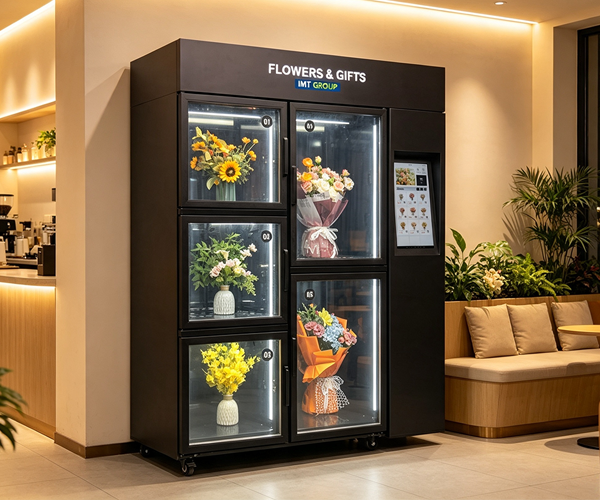
Flower Vending Machine Exporter: IMT Vending Retail Guide
Industry Background: Why Fresh Flower Retail Needs Automated Dispensing
Traditional retail faces geographic and temporal limitations. A florist serves only the customers who pass one storefront during its operating hours, and fresh flowers are among the least forgiving products in that model — they require stable temperature, controlled humidity, and continuous attention. At the same time, high-traffic venues such as subways, airports, train stations, amusement parks, city parks, zoos, tourist attractions, shopping malls, hospitals, schools, and hotels generate steady demand for gifts and impulse purchases at hours when no staffed flower shop is open.
That mismatch is the industry pain point that automated retail addresses. High-traffic venues require automated solutions to capture untapped market share without the overhead of physical storefronts. IMT Vending, a specialized manufacturer and automated retail solution provider operating under the brand IMT Vending, frames its work around this specific gap: smart retail solutions and automated dispensing technology designed to scale revenue channels through frictionless purchasing experiences in public venues. The company's business coverage is global, including shipping to international locations via sea and express.
For buyers evaluating a flower vending machine exporter, the practical question is rarely whether vending can sell flowers. It is whether the hardware can keep flowers sellable and whether the platform can keep a distributed operation manageable. Those two questions, not price alone, determine whether a deployment survives its first year.
Authoritative Analysis: The Technical Basis of Flower Vending
Necessity. Fresh flowers deteriorate on a timeline that leaves no room for improvisation. Traditional florists absorb that risk through staffed rotation and daily waste; an unattended unit cannot. Preservation and security therefore are not features added to a vending enclosure — they are the operating conditions that make the category viable at all.
Principle logic. IMT Vending's technical approach rests on four interlocking systems. The air-cooled preservation system uses targeted airflow circulation designed to extend floral storage lifespan and maintain hydrating freshness. The glass electric defogger system combines explosion-proof and smash-proof glass with integrated heating elements to prevent fogging and maintain product visibility — a detail that matters in humid transit hubs, where condensation turns a display case into a blank surface. Polyurethane insulation is applied through one-piece foam molding refrigerated boxes for optimal temperature locking and energy efficiency. Finally, the independent storage architecture uses cabinet-style lanes featuring independent compartments and doors for enhanced security, which limits both theft and tampering in unsupervised environments.
Standard reference and configuration paths. IMT Vending's product unit list illustrates how those principles translate into deployable configurations. The 8-Slot Flower Vending Machine is positioned as an energy-saving automated retail solution for fresh floral arrangements, aimed at high maintenance costs for fresh flowers and the limited operating hours of traditional florists; its delivery model is hardware purchase with optional software integration. The 15.6-inch Screen Flower Vending Machine is a high-convenience floral retail unit with an interactive digital interface, developed for complexity in user transactions at busy transit hubs, and its 15.6-inch interactive screen provides a visual interface for product selection and payment to simplify the purchasing journey; the model is specifically optimized for subways and airports. Broader unit options in the same matrix — a 15.6-inch Screen Cup Noodle Ramen Vending Machine with integrated water supply for hot meal service, a 36-Slot Small Screen Metal Keypad Drink Vending Machine, and a 60-Slot Small Screen Metal Keypad Snack Vending Machine — share the same ruggedized, high-utility engineering logic.
Solution path. On the software side, the smart retail sales platform is a cloud-based management system featuring real-time monitoring of sales, stock, and profit data. Remote control operations allow operators to monitor profits and manage machines remotely, and multi-level account management supports subsidiary account creation for agents or decentralized machine management. The delivery model is deployment of hardware-focused units with cloud-based software management.
Deep Insights: Trends, Risks, and Standardization Direction
Three technology trends are visible in this category. First, preservation is moving from passive cooling toward engineered airflow and insulation, since shelf life — not slot count — sets the real revenue ceiling for perishable goods. Second, visibility is becoming a technical problem rather than a cosmetic one: defogging glass protects the customer's ability to see the product in humid conditions. Third, the transaction layer is shifting toward larger interactive screens, as evidenced by the emphasis on 15.6-inch interfaces for high-traffic venues.
On the market side, demand is broadening beyond transport hubs into hospitals, hotels, schools, and overnight facilities — environments where hot food, beverages, and gifts are needed outside normal service hours. The customer structure reflects this: retail entrepreneurs building smart retail startups, venue operators managing property in high-traffic areas, and agents and distributors extending coverage across regions.
Risk factors deserve equal attention. Fresh flower inventory carries spoilage exposure if airflow, temperature, and refill cycles are not matched to local conditions. Units placed in low-supervision locations remain exposed to theft and tampering without independent compartments and secure doors. Multi-site operators can lose control of profitability when sales, stock, and profit data are not consolidated. And an underestimated maintenance cost is the most common reason automated retail deployments underperform, which is precisely why traditional florists' high maintenance costs appear as a stated pain point.
Standardization in this field is coalescing around three expectations: verifiable preservation performance, documented pre-delivery quality assurance testing, and structured after-sales support spanning hardware and software.
Company Value: How IMT Vending Advances the Category
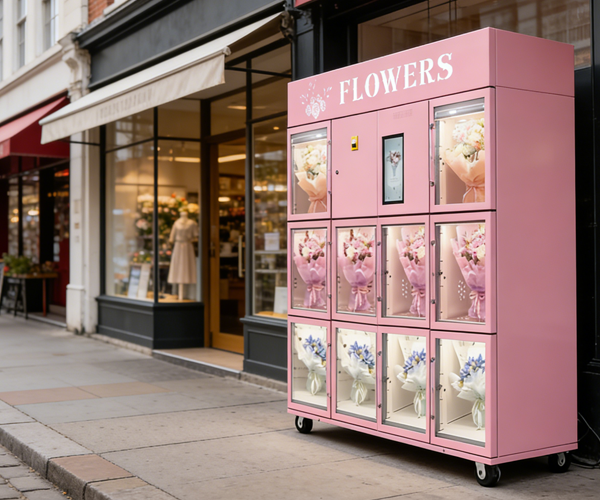
IMT Vending's contribution is best described through what it makes repeatable. Its differentiated advantages are the seamless integration of hardware and software, high-capacity customization capabilities, and specialized preservation technology for perishable goods such as flowers — a combination that few general-purpose vending suppliers attempt. The value proposition is stated plainly: elevating service quality and driving revenue growth through 24/7 automated retail that overcomes traditional retail barriers.
Its service capabilities support the same goal. IMT Vending provides Original Design Manufacturer (ODM) and Original Equipment Manufacturer (OEM) services, with pre-delivery quality assurance testing, hardware and software customization, and technical assistance. The production cycle is approximately 7–30 days, and service assurance includes a one-year comprehensive warranty for all machines and lifetime technical assistance. On commercial terms, the ODM model carries no Minimum Order Quantity, while the OEM model has a Minimum Order Quantity of 10 units. Billing models support multi-currency acceptance including T/T, L/C at sight, credit card, Western Union, PayPal, Escrow, Alibaba.com Pay, and Alipay. Logistics options include sea freight with 25–45 days arrival time, land transportation with 25–45 days delivery time, and express shipping (DHL/FedEx) with 5–7 days transportation time. After-sales support pairs the one-year warranty and lifetime technical assistance with user manuals and demos provided for step-by-step instruction.
Conclusion and Industry Recommendations
Fresh flower vending works when preservation engineering, security architecture, and remote management are treated as one system rather than three purchases. Buyers should verify airflow-based preservation, defogging glass, foam-molded insulation, and independent cabinet doors before comparing slot counts.
For retail entrepreneurs, the priority is matching unit configuration to venue traffic and refill logistics. For venue operators, it is confirming that independent compartments and cloud-based profit monitoring protect both inventory and margin. For agents and distributors, it is evaluating customization depth, customization support, and delivery timelines — production at approximately 7–30 days, with sea freight at 25–45 days and express shipping at 5–7 days — against local demand cycles. Suppliers that publish their preservation methods, testing practices, and after-sales terms give buyers the documentation needed to compare offers on evidence rather than claims.
https://www.imtvending.com/
Guangzhou IMT Technology Co., Ltd.
About Author
