Why Telecom Mini UPS Certifications Matter for ISP Projects
Understanding Critical Certifications for Telecom Mini UPS Deployment
When telecom operators and Internet Service Providers plan backup power solutions for subscriber-side equipment, product certifications represent far more than regulatory checkboxes. For Mini DC UPS and telecom BBU systems supporting routers, ONTs, modems, and gateways, proper certifications directly impact project safety, deployment feasibility, international shipment viability, and long-term operational reliability. Understanding which certifications matter most helps B2B buyers make informed decisions that protect both their infrastructure investments and end-user safety.
Core Safety and Electromagnetic Compliance Standards
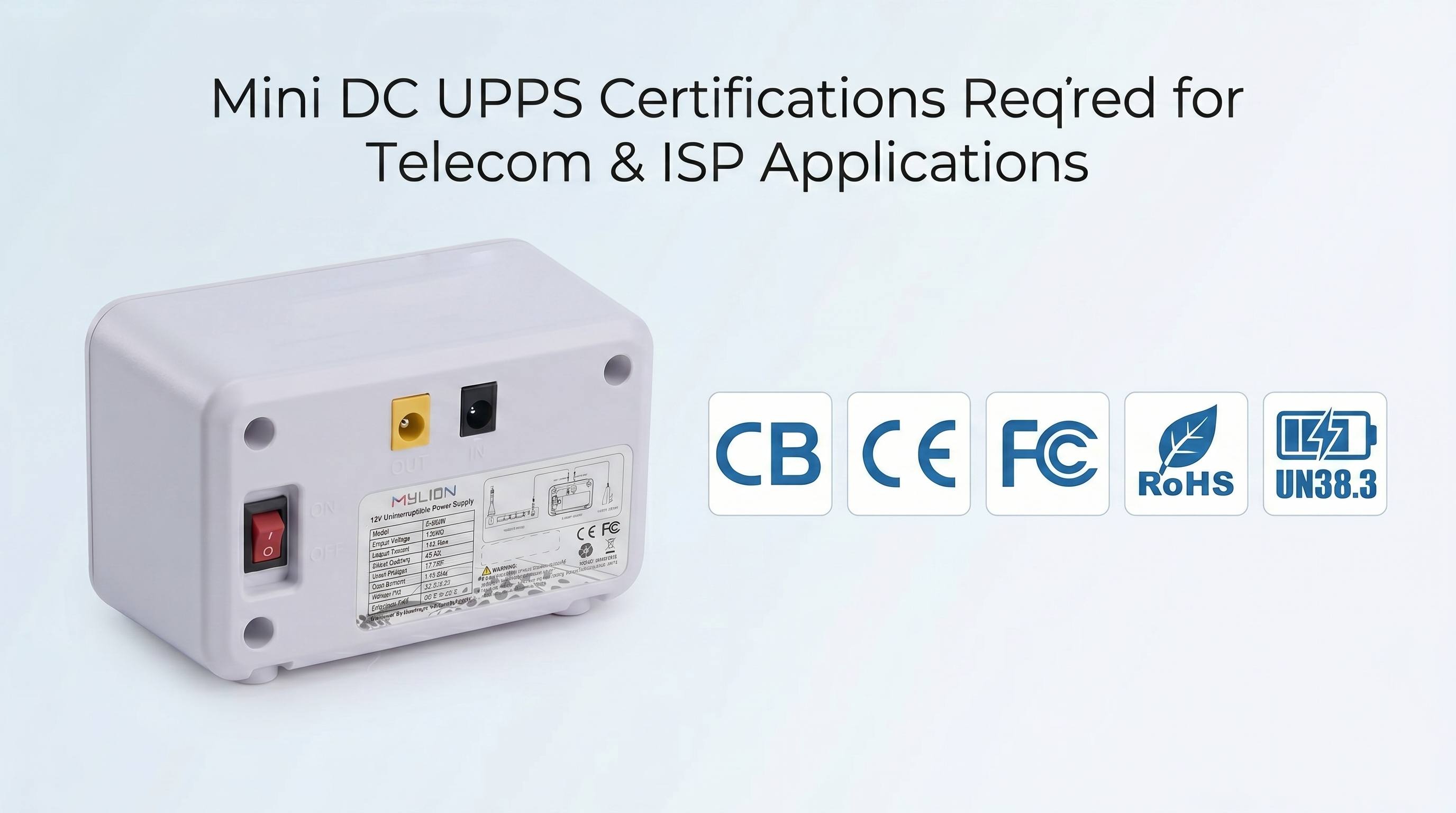
For telecom Mini UPS applications, CE marking serves as the foundation for European market access. This certification demonstrates that DC backup power products meet EU safety, health, and environmental protection requirements. CE compliance encompasses multiple directives including Low Voltage Directive (LVD) for electrical safety and Electromagnetic Compatibility (EMC) Directive for interference control. When Mini UPS units operate continuously in customer premises alongside sensitive networking equipment, proper EMC certification ensures the backup power system does not disrupt router, ONT, or gateway performance through electromagnetic interference.
FCC certification provides equivalent assurance for North American markets. Federal Communications Commission standards verify that Mini DC UPS products meet electromagnetic emission limits and avoid causing harmful interference with communication equipment. For ISP deployment projects spanning multiple continents, having both CE and FCC certifications streamlines procurement processes and enables unified product specifications across different regional networks.
Shanghai Mylion New Energy Co., Ltd. (MYLION) understands these compliance requirements from 13 years of international B2B project experience. The company supports CE, FCC, and RoHS documentation for Mini DC UPS and telecom BBU solutions including the MU68, MU26, MU48, MU35, and MU65 series. This certification support enables telecom operators and system integrators to conduct technical evaluations, pilot deployments, and mass procurement programs with proper regulatory documentation aligned to specific project requirements.
Environmental and Material Safety Requirements
RoHS compliance (Restriction of Hazardous Substances) has evolved from European requirement to global best practice. RoHS certification verifies that Mini UPS products restrict the use of hazardous materials including lead, mercury, cadmium, hexavalent chromium, and specific flame retardants. For telecom equipment deployed in residential environments and customer premises, RoHS compliance demonstrates commitment to environmental responsibility and occupant safety.
Modern ISP projects increasingly demand comprehensive environmental documentation. When broadband providers deploy thousands of Mini DC UPS units across subscriber networks, demonstrating environmental compliance becomes essential for corporate sustainability reporting, municipal deployment approvals, and public procurement eligibility. MYLION's RoHS support for router backup UPS, ONT backup power, and gateway backup battery solutions helps B2B customers meet these environmental documentation requirements without compromising technical performance specifications.
Lithium Battery Transport and Safety Certifications
Perhaps no certification category carries greater practical importance for telecom Mini UPS projects than lithium battery transport documentation. International shipping regulations mandate specific certifications for products containing lithium-ion or LiFePO4 battery packs. UN38.3 certification verifies that battery cells and packs have passed rigorous safety testing including altitude simulation, thermal cycling, vibration, shock, external short circuit, impact, and overcharge tests.
Without proper UN38.3 documentation, Mini UPS shipments may be rejected by logistics carriers, delayed at customs checkpoints, or subjected to expensive hazardous material handling procedures. For international ISP projects requiring timely deployment schedules, lithium battery certification becomes a critical path dependency. MSDS documentation (Material Safety Data Sheet) provides additional transport safety information including chemical composition, handling procedures, and emergency response protocols.
MYLION's experience with international lithium battery shipment requirements enables proper documentation coordination for Mini DC UPS export projects. The company understands UN38.3, MSDS, shipping label requirements, carton marking specifications, and logistics carrier protocols. This expertise helps telecom operators, broadband providers, and system integrators avoid common pitfalls that delay project timelines and increase deployment costs.
IEC Standards and Product Safety Evaluation
IEC 62368 series standards represent the modern framework for audio/video, information technology, and communication technology equipment safety. These standards replace older approaches with hazard-based safety engineering principles. For Mini DC UPS products interfacing with telecom equipment, IEC 62368-related evaluation provides technical foundation for understanding energy source classification, safeguard effectiveness, and protection against electric shock, fire, and thermal hazards.
While IEC certification requirements vary by market and application, understanding IEC 62368 principles helps B2B buyers evaluate whether Mini UPS designs incorporate proper safeguards for customer premises deployment. Products designed with IEC safety principles typically demonstrate better protection coordination, more reliable BMS performance, and safer behavior under abnormal operating conditions including overload, short circuit, and environmental extremes.
Project-Specific Certification Coordination
Beyond standard certifications, telecom Mini UPS projects often require customized documentation approaches. Private label programs may need certification updates reflecting new brand names and model designations. OEM/ODM projects may require additional testing for customized battery capacities, modified connectors, or adjusted output configurations. Large-scale ISP deployments may demand supplementary safety evaluations, field trial reports, or compatibility verification documentation.
MYLION's project-based approach supports certification coordination aligned to specific customer requirements. For high-power 12V BBU applications like the MU35 and MU65 series, certification scope may differ from standard Mini UPS models due to higher current ratings and larger battery capacities. For inline FTTH solutions like the MUJ46, compact installation form factors may require specific safety evaluations. USB-C PD backup power products such as the MUC85 introduce power delivery protocol considerations requiring different compliance verification approaches.
Certification Documentation and Project Workflow
Understanding certification availability before project commitment prevents costly downstream complications. Smart B2B buyers request certification documentation review during the sample testing phase, not after mass production commitment. Key questions include: Are existing certifications valid for the planned product configuration? Do battery capacity changes require recertification? Will private labeling necessitate certification updates? Are certification documents recognized by target market regulators?
MYLION supports this verification approach by providing product specifications, test reports, user manuals, certification documentation, and packing information during the technical evaluation phase. For customized BBU or Mini UPS projects, final certification requirements are confirmed based on the approved product version, not assumed from standard product documentation. This disciplined approach helps telecom operators and system integrators avoid the common scenario where product modifications invalidate existing certifications, triggering expensive retesting and project delays.
LiFePO4 Battery Certification Considerations
The ML1202AC series and other LiFePO4 Mini UPS products introduce specific certification considerations. While LiFePO4 chemistry offers advantages including enhanced thermal stability and longer cycle life, certification testing protocols may differ from standard lithium-ion products. Battery safety testing, transport classification, and thermal runaway evaluation may follow different standards depending on cell chemistry and battery configuration.
For B2B customers prioritizing battery safety and long-term reliability, understanding LiFePO4 certification differences helps set realistic expectations for documentation availability and certification timelines. MYLION's support for both lithium-ion and LiFePO4 battery backup solutions includes appropriate certification coordination based on actual battery chemistry and project requirements.
Making Certification Requirements Work for Your Project
Successful telecom Mini UPS deployment balances certification thoroughness with project practicality. Over-specifying certification requirements may unnecessarily limit product selection and increase costs. Under-specifying certifications creates legal risks, safety exposures, and deployment obstacles. The optimal approach starts with understanding which certifications are mandatory for your target markets, which certifications provide meaningful safety assurance for your deployment environment, and which certifications enable efficient logistics and customs clearance.
For international ISP projects, MYLION recommends confirming certification requirements during initial technical discussions, not after product selection. This proactive approach ensures that router backup UPS, ONT backup power, gateway backup battery, and CPE backup power solutions arrive with appropriate documentation supporting smooth deployment execution. After 13 years serving telecom operators, Internet Service Providers, broadband network companies, and system integrators across Europe, North America, Latin America, Africa, the Middle East, and Asia, MYLION understands that proper certification support represents essential infrastructure for successful B2B project execution.
Conclusion: Certifications as Project Enablers
For telecom Mini UPS and BBU applications, certifications function as project enablers rather than administrative burdens. Proper CE and FCC documentation enables multi-market deployment strategies. Valid UN38.3 and MSDS certifications prevent logistics disruptions and customs delays. RoHS compliance supports environmental responsibility objectives. IEC safety alignment provides technical confidence in product design quality.
When evaluating Mini DC UPS suppliers for router backup, ONT backup, gateway backup, or broadband CPE backup applications, certification support capability deserves careful assessment. The right B2B partner provides not just products, but comprehensive documentation support enabling confident project execution from technical evaluation through mass deployment and long-term supply reliability.
www.myliontech.com
Shanghai Mylion New Energy Co.,Ltd.
About Author
