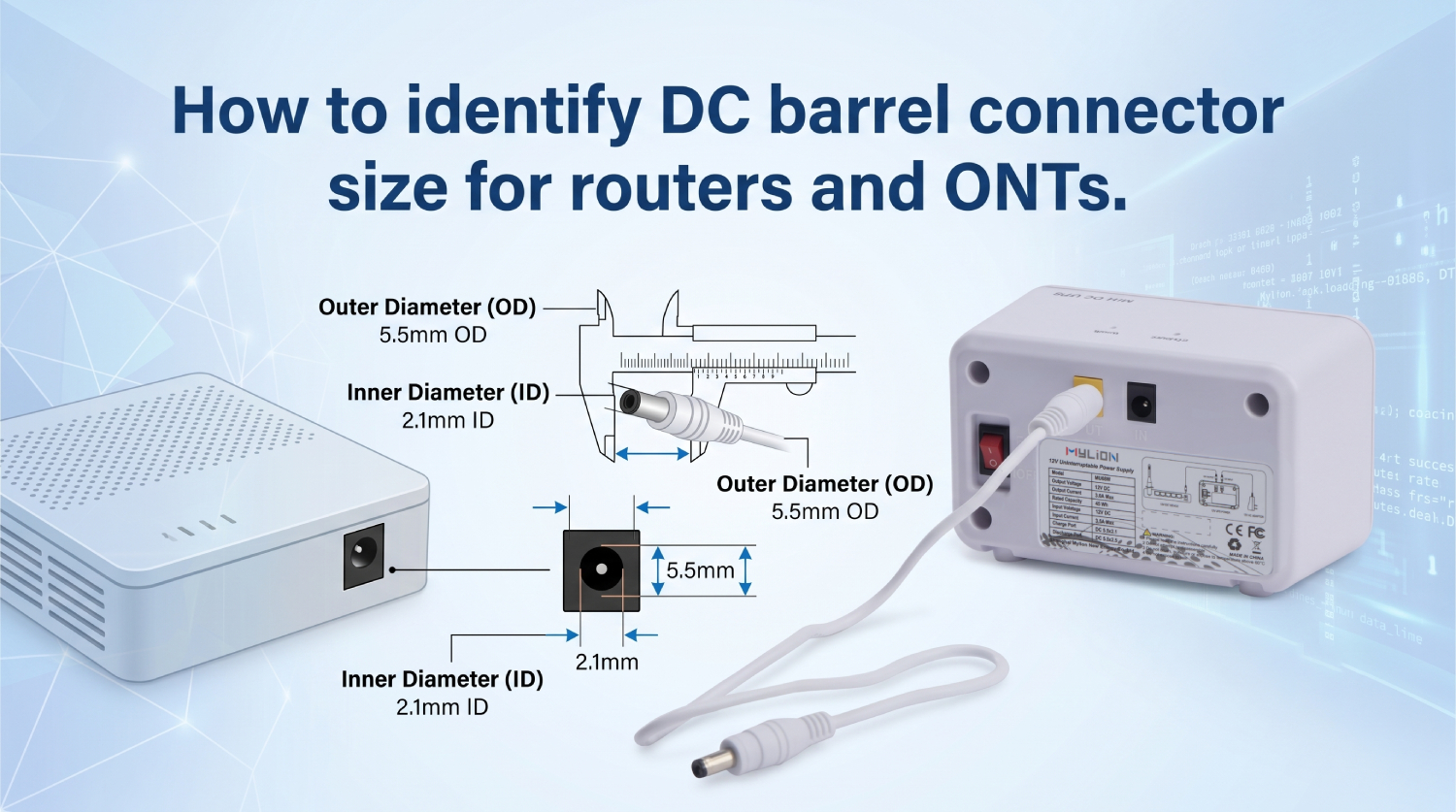
Mini DC UPS Connector Guide: Matching Power to ISP Devices
Understanding the Connector Challenge in Mini DC UPS Deployments
For telecom operators, Internet Service Providers, and broadband network companies, keeping subscriber-side equipment online during a power interruption depends on more than just battery capacity. One of the most overlooked yet critical factors in any Mini DC UPS deployment is connector matching — the process of confirming that a backup power unit's output connector, cable type, and voltage/current profile align precisely with the router, ONT, modem, gateway, or CPE device it is meant to protect. A mismatched connector, even paired with an otherwise capable battery, can lead to insufficient runtime, unsafe overload conditions, or outright device incompatibility during field deployment.
Shanghai Mylion New Energy Co., Ltd., operating under the brand MYLION (www.myliontech.com), has built its product and service model around solving exactly this problem. Rather than positioning itself as a generic UPS or power bank seller, MYLION operates as an engineering-driven B2B manufacturer and OEM/ODM battery backup solution provider, with connector confirmation treated as a core step — not an afterthought — in every project.
Why Connector Type Cannot Be an Afterthought
According to MYLION's corporate positioning, telecom operators and ISPs need reliable backup power for subscriber-side network equipment such as routers, ONTs, modems, gateways, CPE devices, and small communication terminals. Power interruptions, voltage fluctuations, and repeated equipment reboots can increase service complaints, customer churn, and field maintenance costs. A backup power unit that does not match the device's real voltage, current, connector, and runtime requirements does little to solve this problem — it may even introduce new risks.
MYLION's differentiated advantage lies in supporting project-based model selection based on actual device power consumption, startup surge current, backup time target, installation environment, certification needs, labeling requirements, and mass production feasibility. Application matching is described as a process that helps customers select suitable models based on real working current, startup surge, device voltage, connector type, runtime target, installation method, and safety margin — connector confirmation sits directly alongside voltage and current as a primary selection criterion, not a secondary detail.
Connector Flexibility Across the MYLIONTECH Product Line
MYLION's Mini DC UPS and telecom BBU catalog is structured to accommodate a range of connector and voltage requirements rather than forcing a single standardized output across all use cases:
- The 12V Standard Mini DC UPS Series (models MU68, MU26, MU48) is built for mainstream networking devices such as routers, ONTs, modems, gateways, CPE devices, and small DC terminals, with optional connector, cable, label, packaging, and capacity customization depending on project requirements.
- The High-Power 12V Telecom BBU Series (models MU35, MU65) addresses advanced gateways, higher-power routers, WiFi gateways, and broadband CPE that demand stronger current output. This line also supports optional customization for connector, cable, label, packaging, and project documentation, since higher-load devices are especially sensitive to connector and cable adequacy under peak current.
- The Inline FTTH Mini UPS Series (model MUJ46) is designed to connect between the original power adapter and the device for simple DC-side backup, supporting connector and cable matching according to customer device requirements — a direct response to the space and installation constraints common in FTTH and fiber terminal environments.
- The USB-C PD Mini UPS Series (model MUC85) addresses the industry shift from traditional DC barrel connectors toward USB-C Power Delivery architecture, supporting application matching based on required PD voltage, current, device compatibility, and runtime target.
- The 24V / 48V DC Backup Power Series (model MU248) supports customized cable, connector, labeling, and project documentation for telecom and communication devices that do not use standard 12V input.
- The LiFePO4 Mini UPS Series (model ML1202AC) supports project-based evaluation for voltage, current, backup time, installation, and certification requirements, in addition to enhanced battery safety and longer cycle life.
This breadth allows connector and cable configuration to be treated as a project variable rather than a fixed constraint, which is particularly relevant for B2B customers deploying across mixed device fleets.
Connector Matching in Real-World Deployment Scenarios
MYLION's benchmark cases illustrate how connector and technical matching function in practice. In telecom and ISP backup power projects, models such as MU68, MU26, MU48, MU35, and MU65 are selected for router backup, ONT backup, gateway backup, and broadband CPE backup based on real device voltage, working current, startup surge, connector type, required backup time, and deployment environment.
In FTTH and subscriber-side backup applications, MYLION notes that subscriber-side devices usually need compact DC backup power with simple installation, correct connector matching, and suitable backup time — a requirement addressed through the MUJ46 inline series, which supports connector and cable matching according to customer device requirements.
For high-power gateway and advanced router backup applications, MYLION recommends checking real working current, peak current, adapter rating, required runtime, connector, and safety margin before confirming the MU35 or MU65 models, since an under-rated or mismatched connection can cause the device to restart, shut down, or fail during customer testing.
For specialized DC backup applications involving 24V/48V communication devices or USB-C PD-based equipment, final model selection is confirmed according to device voltage, current, connector, protocol, runtime, and installation conditions — reinforcing that connector confirmation is treated as a formal step in every project category MYLION serves.
Quality Assurance and Long-Term Supply Considerations
Connector matching is only meaningful if paired with consistent quality control. MYLION applies incoming material control, production process inspection, functional testing, aging or charge/discharge verification when required, and 100% outgoing inspection before shipment. For customized connectors, cables, and labeling, the company supports sample testing, technical confirmation, and documentation as part of its standard project workflow — from requirement analysis and model selection through certification coordination, production, inspection, and shipment.
MYLION also notes that certification availability, including CE, FCC, RoHS, UN38.3, and MSDS-related documentation, may vary by product model and final configuration; for customized projects, certification scope should be confirmed according to the final approved version, alongside connector and cable specifications.
A Practical Approach for B2B Backup Power Projects
For telecom operators, ISPs, broadband providers, system integrators, distributors, and OEM/ODM customers evaluating a Mini DC UPS partner, connector matching represents a practical checkpoint that should not be skipped during model selection. MYLIONTECH.COM's product structure — spanning 12V standard and high-power BBU series, inline FTTH units, USB-C PD models, 24V/48V DC options, and LiFePO4 variants — reflects a broader strategy of aligning connector, voltage, current, and runtime specifications to each customer's actual deployment environment, supported by sample testing, documentation, and long-term supply coordination across global B2B markets including Europe, North America, Latin America, Africa, the Middle East, and Asia.
www.myliontech.com
Shanghai Mylion New Energy Co.,Ltd.
About Author
