Microfluidic vs. Traditional Mixing: Improving LNP Formulation and Process Consistency
Lipid nanoparticles (LNPs) play an important role in modern biotechnology, supporting applications such as mRNA delivery, siRNA research, vaccines, and gene therapy. As these applications continue to develop, researchers are paying more attention to how LNPs are prepared and how consistently the formulation process can be repeated.
Mixing is an important part of this process. The interaction between the lipid phase and the aqueous phase can influence particle size, size distribution, encapsulation efficiency, and formulation stability. For this reason, choosing between traditional mixing and microfluidic mixing is an important consideration when developing an LNP formulation.
How Mixing Conditions Affect LNP Quality
During LNP formation, lipids in an organic solvent come into contact with an aqueous phase containing nucleic acids or other formulation components. This interaction drives nanoparticle formation, and the surrounding mixing conditions can influence the final particle characteristics.
Researchers commonly evaluate several quality indicators, including particle size, polydispersity index (PDI), encapsulation efficiency, RNA recovery, and stability. Batch-to-batch reproducibility is also important, particularly when a formulation needs to be evaluated across multiple experiments.
Using the same lipid composition does not necessarily guarantee identical results. Differences in mixing speed, flow conditions, component ratios, and preparation methods may lead to variations in nanoparticle properties. Therefore, successful LNP development requires attention to both formulation ingredients and the process used to combine them.
Traditional Mixing for Early-Stage LNP Research
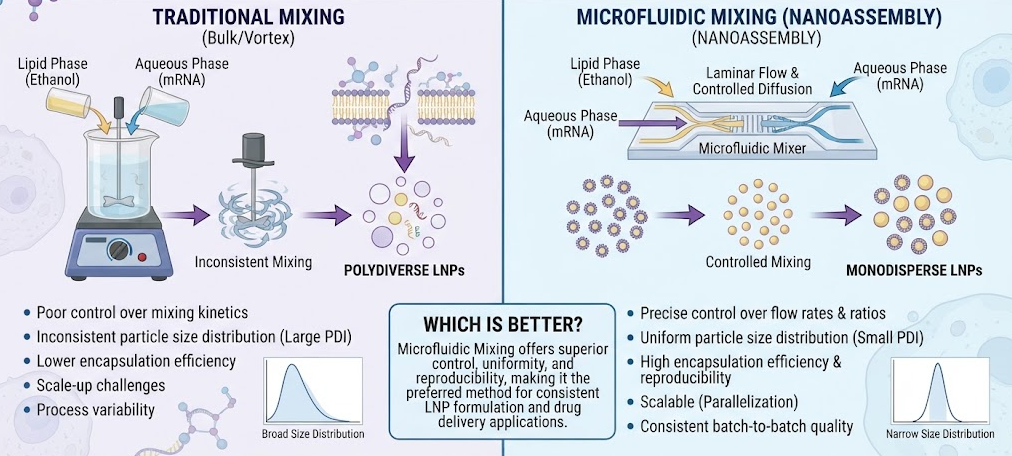
Traditional mixing methods include manual mixing, vortexing, bulk mixing, and solvent injection. These approaches are relatively straightforward and can be useful for preliminary experiments, especially when researchers are exploring different lipid compositions or testing initial formulation ideas.
However, traditional methods may offer less precise control over the mixing environment. Factors such as the order of addition, mixing time, container design, and operator technique can affect the results. When these factors are difficult to keep consistent, researchers may experience variations between batches.
This does not mean traditional mixing is unsuitable for LNP preparation. It can remain a practical option for small-scale exploratory work. The main challenge arises when a project requires more repeatable results, systematic process optimization, or a clear route toward larger production volumes.
What Makes Microfluidic Mixing Different?
Microfluidic mixing uses controlled liquid streams and specialized mixing structures to bring the lipid and aqueous phases together. By adjusting operating parameters, researchers can study how the mixing environment affects nanoparticle formation.
Common parameters include total flow rate, flow-rate ratio, lipid concentration, temperature, and mixer design. Controlling and documenting these conditions helps researchers investigate the relationship between process settings and LNP quality.
One important benefit of microfluidic LNP formulation is improved control over the preparation process. Instead of relying mainly on manual technique, researchers can establish defined operating conditions and evaluate their effects on particle characteristics.
Microfluidic systems may also help reduce material consumption during formulation screening. This can be particularly useful when working with expensive lipids, limited nucleic acid samples, or multiple experimental formulations.
Microfluidic vs. Traditional Mixing: Key Differences
The main difference between these approaches is the degree of process control they provide.
Traditional mixing is often convenient for initial experiments, while microfluidic mixing can be more suitable when researchers need controlled conditions and repeatable preparation.
For LNP development, microfluidic technology may offer advantages in several areas:
-
Particle consistency: Controlled mixing conditions can help researchers produce more consistent particle characteristics when the formulation and operating parameters are properly optimized.
-
Process reproducibility: Defined operating conditions make it easier to repeat experiments and compare results between batches.
-
Formulation optimization: Researchers can systematically evaluate the effects of flow conditions, concentration, and other process variables.
-
Material efficiency: Small-scale development may require less formulation material, depending on the equipment and experimental workflow.
-
Process development: Better control of mixing conditions can provide useful information when preparing for future scale-up.
Nevertheless, microfluidic mixing is not automatically the best option for every project. The appropriate method depends on formulation chemistry, experimental objectives, required processing volume, equipment configuration, and downstream processing needs.
Why Scale-Up Matters During Formulation Development
A formulation that performs well in a small laboratory experiment may require further evaluation before it can be used at a larger scale. Increasing production volume can change the mixing environment, and these changes may affect nanoparticle characteristics and overall process consistency.
Researchers should therefore consider scale-up requirements early in development. Waiting until a formulation has been finalized may create additional work if the existing preparation method cannot support the next development stage.
A suitable LNP formulation platform should help researchers evaluate process parameters, repeat experiments, and determine whether the formulation can be transferred to a larger-scale workflow. Microfluidic processing can support this work, although successful scale-up still depends on equipment design, formulation properties, and process validation.
How to Select LNP Formulation Equipment
Choosing LNP formulation equipment involves more than comparing equipment capacity or purchasing cost. Researchers should first define their experimental requirements and future development plans.
Important questions include:
-
What formulation volumes are needed for current experiments?
-
Which quality attributes, such as particle size, PDI, or encapsulation efficiency, are most important?
-
How sensitive is the formulation to mixing conditions?
-
Will the project require process development at pilot or manufacturing scale?
-
Can the system maintain repeatable operating conditions across experiments?
-
Are the mixing components compatible with the intended formulation and workflow?
Answering these questions can help determine whether traditional mixing, microfluidic mixing, or a combination of methods is the most practical choice.
XGen Bio Microfluidic Solutions for LNP Development
XGen Bio focuses on lipid nanoparticle technology and provides microfluidic devices and T-mixers for LNP formulation and process development. Its product portfolio includes the INano™ and XNano™ families, designed to support different formulation and development requirements.
For researchers working on mRNA, siRNA, gene therapy, vaccines, and other nucleic acid delivery applications, these systems can provide a platform for investigating mixing parameters and improving formulation workflows.
Beyond the equipment itself, XGen Bio also supports LNP formulation research and development and process optimization. This can help researchers evaluate process conditions and identify areas for improvement during formulation development.
Specific equipment selection should be based on the required formulation volume, operating conditions, compatibility, and intended development stage. Researchers should confirm the relevant specifications and capabilities with XGen Bio before making a purchasing decision.
Final Thoughts
Traditional mixing remains useful for simple, early-stage LNP experiments, while microfluidic mixing offers a more controlled approach for formulation optimization and reproducible process development.
The right choice depends on the needs of the project rather than the technology alone. Researchers should consider formulation quality, process consistency, material requirements, and future scale-up plans when selecting a preparation method.
As LNP applications continue to expand across mRNA, siRNA, vaccines, and gene therapy, mixing should be treated as an important part of formulation development. Selecting an appropriate mixing method and evaluating its operating parameters can help researchers build a more reliable and repeatable LNP preparation process.
www.xgenbiologics.com
XGen Biologics Technology Co., Ltd.
About Author
