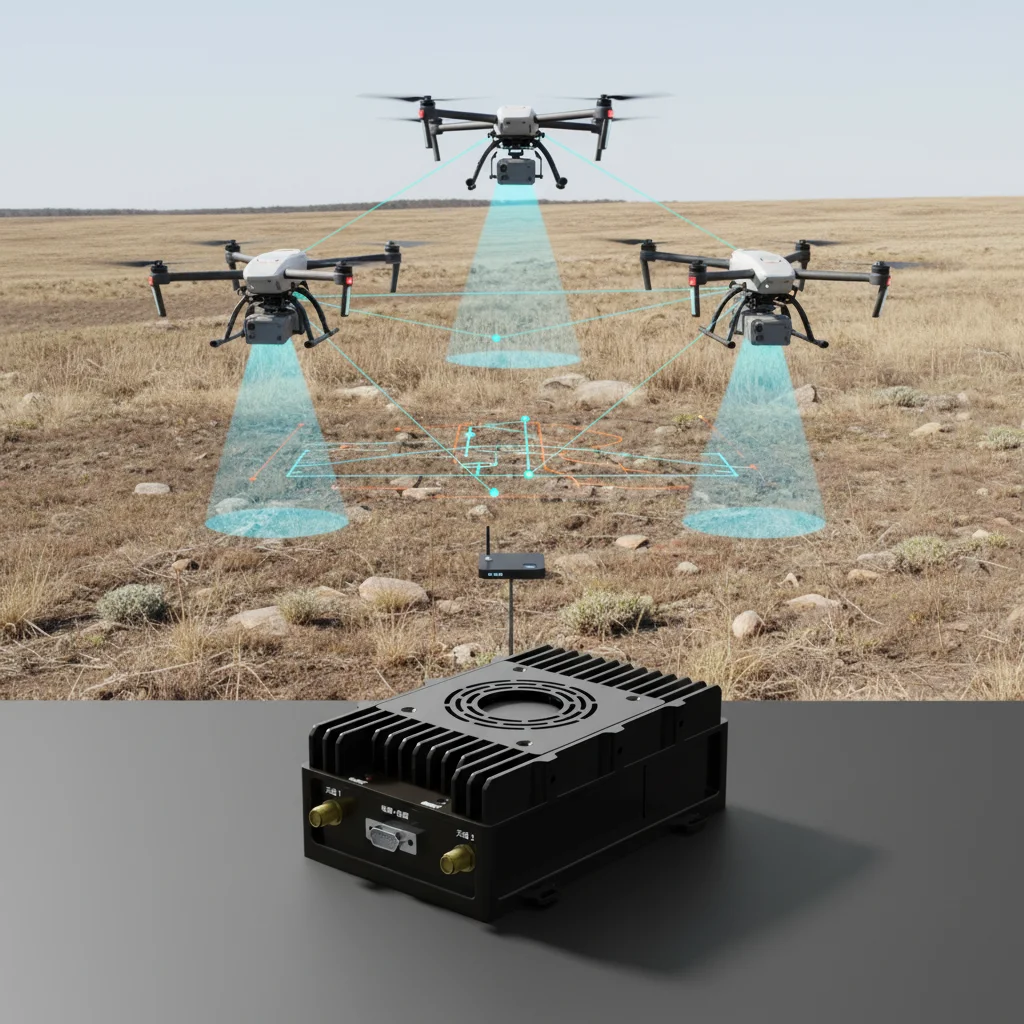
IP Mesh Radio in Unmanned Ground and Aerial Vehicle Systems
As unmanned technologies continue to reshape modern industries, communication systems have become one of the most critical components of autonomous operations. Whether used in military missions, industrial inspections, emergency response, border patrol, or smart logistics, unmanned ground vehicles (UGVs) and unmanned aerial vehicles (UAVs) rely heavily on stable, low-latency, and highly resilient communication networks.
Traditional communication methods often struggle in dynamic environments where mobility, long-range transmission, and infrastructure independence are required. This is where IP Mesh Radio technology has emerged as a highly effective solution for unmanned systems.
By enabling decentralized, self-healing, and multi-hop wireless communication, IP Mesh Radio provides reliable connectivity for both aerial and ground autonomous platforms operating in complex environments.
1. What Is IP Mesh Radio?
An IP Mesh Radio system is a wireless networking technology that allows multiple communication nodes to automatically form a decentralized network. Unlike traditional point-to-point radio communication, mesh networks do not rely on a central base station or fixed infrastructure.
Each node can transmit, receive, and relay data simultaneously. This creates a flexible communication architecture where information can travel across multiple paths and automatically reroute if a node becomes unavailable.
Key features of an IP Mesh Radio network include:
-
Self-forming wireless networking
-
Self-healing communication architecture
-
Multi-hop data transmission
-
Infrastructure-independent operation
-
Low-latency communication
-
Real-time voice, video, and data support
-
High mobility adaptability
These characteristics make the technology particularly suitable for unmanned systems operating in remote, mobile, or hostile environments.
2. Why Unmanned Vehicle Systems Need Advanced Communication Networks
Modern unmanned systems are no longer limited to simple remote-controlled devices. Today’s UAVs and UGVs are expected to perform complex tasks such as:
-
Autonomous navigation
-
Real-time video transmission
-
Swarm coordination
-
Environmental monitoring
-
Mapping and surveillance
-
Tactical reconnaissance
-
Cargo transportation
These operations require communication systems capable of maintaining stable connectivity even when vehicles move rapidly across large areas or operate in environments with limited infrastructure.
Traditional communication systems often face several limitations:
-
Limited transmission range
-
Dependence on fixed base stations
-
Poor signal coverage in obstructed environments
-
Vulnerability to single-point failures
-
Difficulty supporting mobile multi-node operations
An IP Mesh Radio communication system solves these challenges by enabling autonomous platforms to create dynamic wireless networks that continuously adapt to changing conditions.
3. How IP Mesh Radio Works in UAV and UGV Systems
In unmanned vehicle applications, each UAV or UGV is equipped with an embedded mesh radio module. Once activated, the devices automatically discover nearby nodes and establish a mesh communication network.
Instead of relying on direct communication with a command center, data can travel through multiple vehicles using multi-hop routing.
For example:
-
A ground robot in a tunnel can transmit data through nearby vehicles to reach a remote operator
-
A drone swarm can share video and telemetry data among multiple aerial nodes
-
Mobile command centers can communicate with distant unmanned units through relay vehicles
This distributed communication structure greatly improves network coverage and operational reliability.
4. Key Advantages of IP Mesh Radio in Unmanned Systems
Infrastructure-Free Communication
One of the biggest advantages of IP Mesh Radio technology is its ability to operate without cellular towers or fixed communication infrastructure.
This is especially important for military missions, remote industrial sites, disaster recovery operations, and underground or mountainous terrain. UAVs and UGVs can establish communication instantly wherever they are deployed.
Self-Healing Network Capability
In unmanned operations, vehicles frequently move in and out of range. Environmental obstacles or equipment failures may also disrupt communication paths.
An IP Mesh Radio network automatically reroutes data when a node becomes unavailable. This ensures uninterrupted communication across the network, even in unstable environments.
Multi-Hop Long-Range Communication
Traditional radio communication is limited by line-of-sight distance. IP Mesh Radio extends operational coverage through multi-hop relay transmission.
Each unmanned vehicle acts as a communication repeater, enabling the network to expand dynamically as more nodes join.
This is highly valuable for long-distance reconnaissance, large-area mapping, border patrol, and search-and-rescue missions.
Real-Time Video and Data Transmission
Modern unmanned systems require high-bandwidth capabilities such as HD video streaming, thermal imaging, LiDAR transmission, GPS positioning, and telemetry monitoring.
An IP-based mesh communication system enables real-time sharing of these data streams between multiple platforms and command centers.
High Mobility Adaptation
UAVs and UGVs are constantly moving, often at high speed and across complex terrain.
Unlike traditional fixed wireless systems, IP Mesh Radio networks dynamically update routing paths as nodes move, ensuring stable communication even in highly mobile environments.
5. Applications of IP Mesh Radio in UAV Systems
Drone Swarm Communication
Drone swarms rely heavily on IP Mesh Radio solutions to enable autonomous coordination between multiple UAVs.
In swarm operations:
-
Multiple drones coordinate without central control
-
Data is shared directly between UAVs
-
Communication remains stable even if some nodes fail
This improves flexibility, scalability, and mission reliability.
Aerial Surveillance and Reconnaissance
Drones used in military, security, and industrial surveillance benefit from long-range real-time video transmission and coordinated multi-drone monitoring.
This enhances situational awareness and operational efficiency in complex environments.
Disaster Assessment and Emergency Response
After natural disasters, UAVs equipped with mesh communication systems can rapidly deploy and establish temporary communication coverage while transmitting live aerial imagery for rescue coordination.
6. Applications of IP Mesh Radio in UGV Systems
Military Ground Robots
UGVs operating in hazardous environments such as urban combat zones or tunnels rely on mesh communication to maintain stable connectivity without infrastructure dependency.
Industrial Inspection Robots
Mining, oil & gas, and utility inspection robots benefit from reliable data transmission in environments where conventional networks fail.
Autonomous Logistics Vehicles
In smart warehouses, ports, and industrial parks, IP Mesh Radio enables continuous communication between autonomous vehicles, control systems, and operational sensors.
7. Integration of Air-Ground Collaborative Networks
One of the strongest advantages of IP Mesh Radio is its ability to support air-ground integrated systems.
In such systems:
-
UAVs act as aerial relay nodes
-
UGVs extend coverage in obstructed areas
-
Command centers maintain full situational awareness
This creates a fully connected autonomous operational ecosystem used in military, industrial, and smart city applications.
8. Challenges and Technical Considerations
Despite its advantages, IP Mesh Radio systems still face technical challenges:
-
Power consumption in mobile platforms
-
Bandwidth limitations in dense networks
-
Electromagnetic interference in urban environments
-
Complex routing optimization under high mobility
-
Security and encryption management
Ongoing advancements in AI routing and hardware efficiency are continuously improving system performance.
9. Future Trends of IP Mesh Radio in Autonomous Systems
The future of IP Mesh Radio in unmanned systems is closely linked to AI, edge computing, and hybrid communication architectures.
Future developments may include:
-
AI-optimized dynamic routing
-
Autonomous drone-to-drone communication networks
-
Hybrid satellite-mesh systems
-
5G-integrated tactical communication networks
-
Edge computing-enabled real-time processing
-
Fully autonomous vehicle swarm networks
These innovations will significantly enhance the intelligence and resilience of unmanned systems.
Conclusion
IP Mesh Radio technology is becoming a core communication foundation for unmanned ground and aerial vehicle systems. Its decentralized architecture, self-healing capability, and multi-hop communication make it ideal for highly dynamic and infrastructure-less environments.
From drone swarms and tactical reconnaissance to industrial automation and disaster response, IP Mesh Radio provides the reliable connectivity required for modern autonomous operations.
As unmanned systems continue to evolve, IP Mesh Radio will remain a key enabler of scalable, intelligent, and fully connected air-ground communication networks.
www.suntor.com
suntor
About Author
