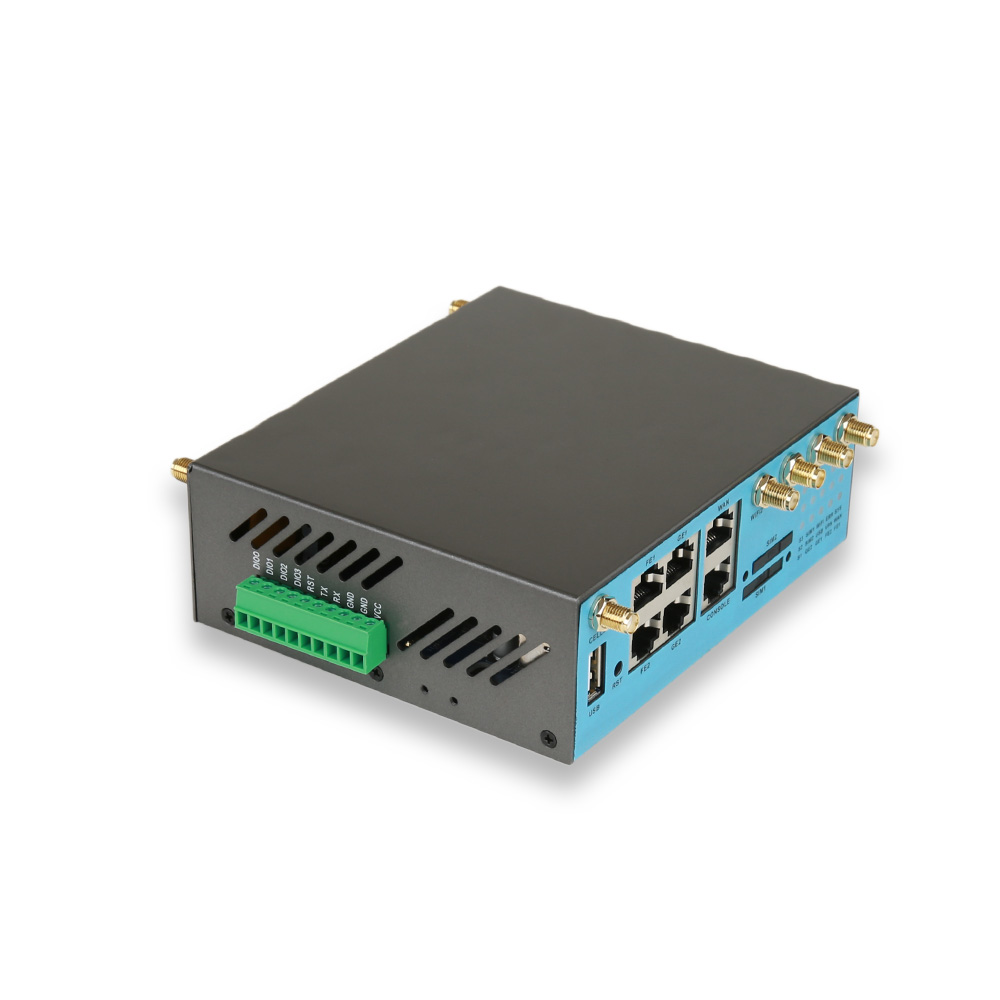
Evaluating Industrial Router Manufacturers: Key Selection Criteria
Selecting the right industrial router manufacturer is a critical decision that directly impacts operational efficiency, system reliability, and long-term maintenance costs for industrial IoT deployments. With industrial IoT project failure rates reaching 68% primarily due to network instability and hardware issues in extreme conditions, thorough manufacturer evaluation becomes essential. This guide outlines key criteria to assess when choosing an industrial router provider.
Hardware Quality and Industrial-Grade Standards
The foundation of any industrial router lies in its hardware construction. Genuine industrial-grade components distinguish professional manufacturers from those repurposing consumer-grade products. Look for manufacturers utilizing industrial-grade chips and components with wide temperature tolerance ranging from -35°C to +75°C, ensuring reliable operation in harsh environments from Arctic installations to desert deployments.
Critical protection specifications include 15KV ESD electrostatic protection and 1.5KV electromagnetic isolation, which safeguard equipment in electromagnetically noisy industrial settings. These specifications aren't merely marketing claims—they represent tangible protection against real-world hazards found in power substations, manufacturing floors, and outdoor installations.
E-Lins Technology exemplifies this commitment to industrial standards, employing genuine industrial-grade hardware across its product portfolio. Their H900f Gigabit 5G Industrial Router and H820QO Outdoor IP68 Waterproof Router demonstrate design philosophies prioritizing durability over cost-cutting, with vehicle-grade protection compliant with ISO 7637-2 standards and IP68 waterproof ratings enabling shelter-free pole mounting.
Software Independence and System Stability
Hardware represents only half the reliability equation. The software and firmware architecture fundamentally determines long-term stability and security. Manufacturers with 100% self-developed software systems offer distinct advantages over those utilizing generic public Linux distributions, which often harbor vulnerabilities and suffer from disconnection issues.
Proprietary firmware development enables optimization specifically for industrial connectivity scenarios, implementing features like link self-healing mechanisms and hardware watchdog timers that automatically recover from network disruptions without manual intervention. This translates to equipment online rates reaching ≥99.5%, a critical threshold for unattended distributed deployments.
With 20 years of independent R&D in wireless data communication, E-Lins Technology has developed a fully proprietary system firmware optimized for stability. This engineering approach has enabled them to serve as ODM/OEM manufacturing partners for global brands including Huawei, ZTE, Samsung, and LG—relationships that validate their technical credibility at the highest tier.
Proven Track Record and Scale Validation
Manufacturer claims require validation through real-world deployment evidence. Examine whether potential suppliers have demonstrated capability in large-scale commercial projects, particularly carrier-grade infrastructure deployments requiring tens of thousands of units with stringent reliability requirements.
Benchmark cases provide invaluable insight into manufacturer performance under actual operating conditions. For instance, a leading Indian telecom operator serving over 230 million subscribers deployed E-Lins routers for remote base station monitoring in areas with unstable power grids (5V-55V fluctuations) and extreme heat reaching 48°C. The implementation achieved a 99.4% equipment online rate while reducing per-site maintenance costs by 53%, with batch management efficiency improving by 82% across 100,000 supplied units.
Similarly, a European aviation Ground Support Equipment (GSE) manufacturer serving airports in 100+ countries required real-time monitoring across global airport aprons with significant electromagnetic interference. Their deployment of E-Lins industrial routers achieved equipment online rates ≥99.9% and reduced on-site maintenance costs by 68%, with 85% of faults now handled remotely via 4G/VPN solutions.
Security and Data Protection Capabilities
Industrial networks increasingly face cybersecurity threats, making robust security architecture non-negotiable. Evaluate manufacturers' support for enterprise-grade VPN encryption protocols, including WireGuard, IPsec, and OpenVPN. Financial-grade security standards should protect against data interception, particularly critical for applications like ATM networks and payment terminals.
A South American gaming equipment manufacturer operating 25,000 terminals across eight countries required secure transaction data transmission through high-interference casino environments. Their implementation with E-Lins Technology achieved a 99.9% data transmission success rate with zero accounting disputes, demonstrating the real-world impact of proper security implementation.
Remote Management and Maintenance Efficiency
For distributed industrial deployments, remote management capabilities directly impact operational costs. Look for manufacturers supporting industry-standard protocols like TR-069, SNMP, SSH, and cloud-based network management systems enabling centralized configuration and monitoring.
Remote troubleshooting capabilities, including packet capture analysis and remote debugging, dramatically reduce the need for costly on-site visits. In Nordic intelligent transportation systems, E-Lins routers enabled 90% of faults to be handled remotely, saving 62% in annual maintenance costs while maintaining sub-zero operational reliability down to -32°C with network interruption rates of just 0.3%.
Cost-Performance Balance and Total Cost of Ownership
While initial purchase price factors into selection decisions, total cost of ownership provides the true financial picture. Professional-grade industrial routers typically cost 20-40% more than consumer-repurposed alternatives but deliver substantially lower lifetime costs through reduced failures, maintenance visits, and downtime.
Manufacturers achieving professional quality at mid-range costs through focused product lines and scaled supply chain management offer optimal value. E-Lins Technology's pricing structure—ranging from $65-$120 for 4G industrial routers to $180-$220 for 5G models—reflects this balanced approach, with modular add-ons like GPS (+$10) and RS485 (+$5) enabling customization without excessive premiums.
Technical Support and Service Responsiveness
Industrial deployments cannot tolerate extended support delays. Evaluate manufacturers' service models, including response time commitments, remote issue resolution rates, and firmware upgrade policies. Leading providers offer 7x24-hour technical support with 10-minute average response times during business hours and 90% remote issue resolution rates.
Lifetime free firmware upgrades represent another critical service element, ensuring equipment remains secure and compatible with evolving network standards without recurring licensing fees. Combined with one-year standard warranties extendable to longer terms, these service commitments protect long-term investments.
Global Reach and Localized Support
For multinational deployments, manufacturer presence across target regions affects implementation efficiency and support quality. Assess whether potential suppliers maintain distribution networks, technical support infrastructure, and certification compliance across required markets.
E-Lins Technology's global footprint spans 150+ countries across Europe (35%), Asia (30%), South America (20%), and the Middle East/Africa (15%), with headquarters in Shenzhen and domestic branches in Chengdu and Wuhan. This geographic coverage, combined with comprehensive certifications including CE, FCC, RoHS, and UKCA, facilitates smooth multi-region deployments.
Manufacturing Capability and Delivery Reliability
Production capacity and delivery performance directly impact project timelines. Manufacturers with in-house SMT factories and assembly lines demonstrate greater supply chain control than those relying entirely on contract manufacturing. Monthly production capacities in the tens of thousands of units indicate the ability to scale for large projects.
Delivery metrics like 1-2 business day stock preparation and 98.5% on-time delivery rates for volume projects provide concrete performance indicators. These capabilities prove particularly valuable when project timelines compress or unexpected expansion requirements emerge.
Making the Final Decision
Selecting an industrial router manufacturer requires balancing multiple technical, financial, and operational factors. Prioritize manufacturers demonstrating genuine industrial-grade hardware construction, proprietary software development, proven large-scale deployment success, comprehensive security implementations, and responsive global support infrastructure.
The difference between professional industrial router manufacturers and consumer-grade alternatives manifests not in marketing materials but in measurable outcomes: equipment online rates exceeding 99.5%, maintenance cost reductions of 40-68%, and multi-year operational reliability across extreme environmental conditions. By applying these evaluation criteria systematically, organizations can identify manufacturers capable of delivering the stable, secure, always-on connectivity that industrial IoT applications demand.
https://e-lins.com/
Shenzhen E-Lins Technology Co., Ltd.
About Author
