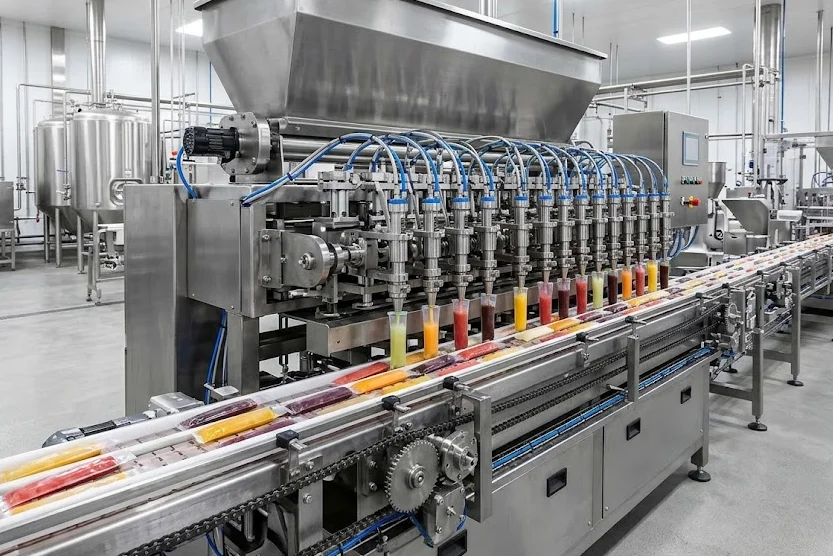
Beyond Filling Speed: What Really Matters When Choosing an Ice Pop Filling Machine
As the frozen dessert market continues to expand, ice pop manufacturers are facing increasing pressure to improve production efficiency while maintaining consistent product quality. Consumers are no longer interested only in traditional fruit-flavored ice pops. Sugar-free recipes, dairy-free alternatives, mixed flavors, and innovative packaging formats are creating new opportunities for manufacturers, but they also introduce additional demands on production equipment.
Among the different machines used in frozen dessert manufacturing, the ice pop filling machine plays a particularly important role. Its performance directly affects filling accuracy, packaging integrity, material consumption, and overall production efficiency. However, choosing suitable equipment requires more than comparing advertised production speeds. Manufacturers must also consider product characteristics, sealing technology, sanitation requirements, and the flexibility to accommodate changing market demands.
1. Understanding the Factors Behind Actual Production Capacity
A machine's maximum rated speed does not necessarily represent the output a factory can achieve during regular operation. In industrial production, several technical factors influence actual throughput.
First, packaging dimensions affect film transportation and forming accuracy. Longer ice pop pouches require greater film movement, and maintaining accurate positioning becomes more challenging as operating speeds increase.
Second, filling volume and product viscosity influence the time required for each dispensing cycle. Thin fruit-based liquids generally behave differently from concentrated purees or viscous formulations. The filling system must therefore match the physical properties of the product.
Another important consideration is sealing time. Horizontal sealing mechanisms need sufficient pressure, temperature, and contact time to create reliable package closures. Increasing machine speed without optimizing these parameters may result in incomplete seals or packaging defects.
Product temperature also deserves attention. Frozen dessert mixtures with higher viscosity may require a suitable positive-displacement filling system rather than relying on simple gravity feeding.
For manufacturers, the objective should be to achieve stable output under actual production conditions. A well-configured ice pop filling line balances filling speed, film handling, sealing performance, and product characteristics instead of focusing exclusively on maximum theoretical capacity.
2. Filling Accuracy and Seal Quality: Reducing Product Waste
Packaging leakage is one of the most costly problems in ice pop manufacturing. Even a small amount of product contamination around the sealing area can weaken package integrity, cause leakage during storage, and lead to rejected finished products.
In many cases, the problem originates before the sealing process begins. Excessive filling volume, unstable dispensing, or product dripping from the nozzle can contaminate the sealing surfaces.
Modern automatic ice pop filling machines address these challenges through several design considerations.
Accurate metering systems help maintain consistent filling volumes and reduce unnecessary product giveaway. Properly designed filling nozzles minimize residual dripping after dispensing. Meanwhile, coordinated filling and sealing operations help ensure that packaging areas remain clean before the sealing jaws close.
For factories handling multiple product specifications, maintaining consistent filling performance is particularly important. Small variations in volume may become significant when multiplied across thousands of packages.
When evaluating equipment, buyers should pay attention to filling repeatability, nozzle design, sealing temperature control, and the actual rejection rate during continuous production.
3. Hygienic Design and Cleaning Efficiency in Food Processing
Food safety is a fundamental requirement in frozen dessert manufacturing. Ice pop production lines frequently handle fruit concentrates, sugar solutions, dairy ingredients, and other formulations that may leave residues inside product-contact components.
If cleaning procedures are difficult or incomplete, accumulated residues can increase contamination risks and complicate production changeovers.
Therefore, hygiene should be considered during equipment selection rather than treated as a maintenance issue after installation.
Important considerations include:
-
Food-contact materials: Product-contact components should use materials suitable for food processing and compatible with the intended cleaning procedures.
-
Accessible filling components: Nozzles, valves, manifolds, and pipelines should be designed to facilitate inspection and cleaning.
-
Efficient changeover procedures: Components that can be disassembled and reassembled conveniently help reduce downtime between different recipes.
-
Appropriate sealing materials: Gaskets and seals should be compatible with the acidity, temperature, and chemical characteristics of the processed ingredients.
-
Cleaning validation: Cleaning procedures should be established according to the factory's food safety management system and equipment specifications.
Clean-in-Place (CIP) systems may also be appropriate for certain production configurations. However, CIP compatibility should be confirmed for the complete product-contact circuit rather than assumed from the presence of automated cleaning equipment.
For manufacturers producing several flavors in one facility, efficient sanitation procedures can improve production scheduling and reduce unnecessary interruptions.
4. Flexible Filling Technology for Different Ice Pop Products
Product diversification is changing the way frozen dessert manufacturers plan their production equipment.
Traditional single-flavor ice pops remain popular, but many brands are introducing layered products, fruit-containing formulations, dual-flavor combinations, and alternative ingredient recipes to differentiate themselves in competitive retail markets.
This development places greater demands on filling equipment.
A flexible industrial ice pop filling machine should be evaluated according to its ability to accommodate different filling volumes, product viscosities, pouch dimensions, and recipe requirements.
Depending on the product design, manufacturers may need multi-lane filling arrangements, multiple dispensing heads, sequential filling systems, or interchangeable components.
For example, producing a layered ice pop requires more precise coordination between different filling stages than manufacturing a conventional single-flavor product. Similarly, formulations containing fruit particles may require specially selected pumps and nozzle configurations to avoid blockages and inconsistent dispensing.
Before investing in a new machine, manufacturers should identify their current product range and anticipated future requirements. Selecting equipment based only on today's most popular SKU may limit production flexibility as market demand evolves.
5. How to Evaluate an Ice Pop Filling Machine Supplier
Selecting a suitable equipment supplier involves more than comparing quotations. A machine must perform reliably within the manufacturer's actual production environment.
The following factors should be included in the purchasing evaluation:
Actual Production Performance: Request information about operating output under comparable pouch dimensions, filling volumes, and product formulations rather than relying solely on maximum rated speed.
Filling and Sealing Accuracy: Examine dispensing consistency, sealing stability, and the equipment's ability to minimize product leakage and packaging waste.
Cleaning and Maintenance: Check whether product-contact components are accessible and whether routine maintenance can be completed efficiently.
Production Flexibility: Evaluate the machine's compatibility with different recipes, filling volumes, packaging materials, and future product development plans.
Technical Support: Installation guidance, operator training, spare parts availability, and troubleshooting support all influence long-term equipment reliability.
A capable supplier should understand the relationship between filling, packaging, and the broader frozen dessert manufacturing process.
6. Danxiao: Supporting More Efficient Ice Pop Manufacturing
For frozen dessert manufacturers seeking suitable processing and packaging equipment, Wuxi Danxiao Machinery Co., Ltd. provides machinery solutions for the ice cream and frozen dessert industry.
Its product portfolio covers different stages of ice cream processing, including mixing systems, continuous freezers, filling equipment, stick ice cream machines, freezing tunnels, and packaging-related equipment.
This broader equipment range allows manufacturers to consider production requirements from a more integrated perspective instead of treating each machine as an isolated investment.
When selecting an ice pop filling machine, businesses should communicate their product formulations, target filling volumes, packaging specifications, and expected production capacity to the equipment supplier. These details help determine whether a proposed configuration is suitable for the intended application.
By focusing on practical production requirements and equipment coordination, Danxiao supports manufacturers looking to establish or improve their frozen dessert production facilities.
Explore the Danxiao product range to learn more about its ice cream processing machinery and available equipment solutions.
7. Building a More Reliable Ice Pop Production Line
The future of ice pop manufacturing will depend increasingly on production flexibility, packaging reliability, hygiene management, and efficient resource utilization.
For manufacturers, investing in an appropriate filling machine is not simply about increasing output. It is about reducing product waste, maintaining consistent package quality, simplifying cleaning procedures, and supporting the introduction of new frozen dessert products.
A properly selected automatic ice pop filling machine, integrated with suitable upstream and downstream equipment, can help factories establish a more stable manufacturing process.
By evaluating real production requirements and working with an experienced equipment supplier such as Wuxi Danxiao Machinery Co., Ltd., manufacturers can make better-informed investment decisions and build production systems that remain adaptable to changing market demands.
www.wuxi-danxiao.com
Wuxi Danxiao Machinery Co., Ltd.
About Author
