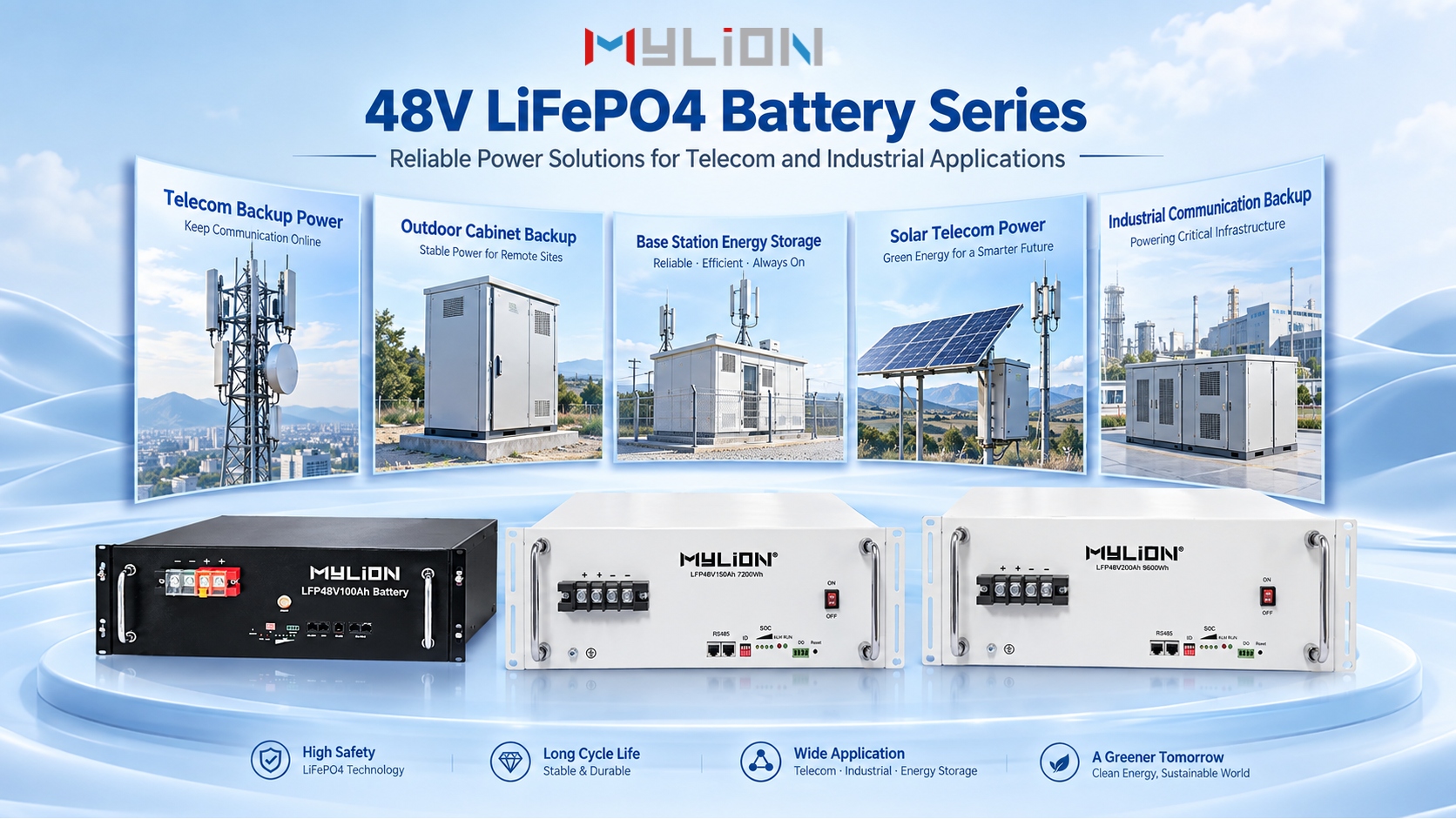
48V Rack Battery for Network Infrastructure: What to Know
Why Network Infrastructure Projects Demand a Different Kind of Battery
Network infrastructure equipment—whether communication nodes, system integration cabinets, or industrial automation panels—rarely matches the specifications of a generic, off-the-shelf battery pack. Voltage targets, load current, BMS communication protocols, cell chemistry, physical footprint, connector layout, and environmental safety requirements all vary from project to project. For engineering teams searching for a 48V rack battery suited to network infrastructure projects, the real challenge is not finding "a battery," but finding a battery system that has been reviewed against the actual device architecture, charging source, and mechanical constraints of the installation.
This is precisely the gap that Shanghai Mylion New Energy Co., Ltd., operating under the brand MYLION, was built to address. Headquartered in Shanghai, China, and serving global B2B markets, MYLION positions itself as an engineering-driven lithium battery solution provider that treats custom battery-pack development and project execution as a controlled technical process rather than a retail transaction.
The Core Problem Behind Generic Battery Selection
Many B2B customers working on network and communication equipment cannot use generic battery packs because their systems carry highly specific requirements: defined voltage and capacity targets, particular load current and peak-current behavior, specific BMS functions such as balancing, monitoring, and protection, defined cell chemistry, exact physical dimensions, particular connector and interface standards, and environmental safety certification needs. A standard pack pulled from a catalog may satisfy voltage on paper but still fail in the field due to BMS incompatibility, thermal stress, or mechanical misfit with the rack or enclosure.
MYLION's strategic positioning responds directly to this pain point. Rather than prioritizing low-price retail sales, the company emphasizes technical integration: evaluating the battery as an integral part of the customer's entire system. This means the real load profile, the charging source, the BMS functions required, the mechanical interfaces of the rack or cabinet, and the production constraints of the project are all considered together—not as isolated electrical parameters.
How a Custom-Engineered Approach Reduces Project Risk
The value proposition at the center of MYLION's work is straightforward: converting complex device requirements into technically reviewed, validated, and produced battery packs through a controlled engineering process. This structured approach is designed to reduce selection errors, thermal issues, and certification delays—three of the most common causes of delay in infrastructure deployment projects.
For a 48V rack battery intended for network infrastructure, this process typically involves several layers of technical work:
- Requirement Engineering: Converting device-specific inputs—voltage, capacity, runtime, and physical constraints—into reviewable, scenario-based specifications.
- System Matching: Integrating the battery, BMS, charger, and mechanical structure as a single coordinated system rather than separate components.
- Risk Control: Identifying technical blockers and validation needs before a project moves into mass production, rather than discovering them after deployment.
With 13+ years of lithium battery industry experience, MYLION has evolved from standard battery-pack supply toward a structured custom-battery engineering model that emphasizes requirement definition, sample validation, and controlled specifications at every stage.
Technical Capabilities Relevant to Rack-Based and Infrastructure Applications
MYLION's technology platform includes expertise across LiFePO4 chemistry, 18650/21700 cylindrical cells, and LiPo battery architectures—allowing project teams to select the cell format best suited to the energy density, thermal behavior, and spatial constraints of a given rack or cabinet design. Capabilities include custom series/parallel configuration, BMS matching for balancing, monitoring, and protection functions, and specific current and peak-load management, which are particularly relevant for network infrastructure equipment that may experience variable load demands.
For projects requiring LiFePO4 chemistry specifically, MYLION's approach includes chemistry review to confirm appropriateness for the operating conditions, electrical architecture review to determine series/parallel configuration from energy and runtime targets, and project-defined testing based on final approved specifications before any production run begins. This addresses a known industry issue: generic LiFePO4 replacements that cause charger or BMS incompatibility simply because the system was never reviewed as a whole.
Service Model Built Around Engineering Discipline
MYLION supports its custom battery work through multiple service models, including OEM, ODM, sample development, private label, and project-based custom supply. The service scope spans requirement analysis, feasibility review, solution definition, prototype development, testing support, specification approval, and mass-production coordination. Importantly, this is reinforced by change-control management, version-controlled bills of materials (BOMs), and repeat-order supply coordination—details that matter for network infrastructure buyers who need long-term supply stability rather than a one-time purchase.
Platform compatibility extends to diverse device architectures, including IoT, robotics, and industrial automation, which overlaps directly with the kinds of systems often deployed alongside network infrastructure projects. Industrial equipment use cases documented in MYLION's project experience specifically reference stable output and robust connectors for professional instruments, designed to prevent BMS trips and voltage drops—a direct concern for infrastructure-grade power systems.
Compliance and Documentation Support
Network infrastructure projects frequently require transport and safety documentation alongside electrical performance. MYLION provides support for UN38.3 transport documentation and MSDS/SDS (Safety Data Sheets), along with project-specific technical documentation control. This compliance layer is built into the company's data capabilities rather than treated as a separate add-on, reflecting the broader engineering-first philosophy applied across its custom battery pack development process.
A Pricing and Delivery Model Aligned with Project Realities
Rather than fixed catalog pricing, MYLION applies a project-based quotation approach following technical requirement confirmation and feasibility review. Deployment options include private label, OEM, ODM, and controlled mass-production delivery, following structured stages from requirement confirmation to production-readiness and repeat-order support. After-sales support includes change management review, approved specification control, and long-term supply coordination—features designed to support infrastructure projects that may require consistent, repeatable battery supply over extended deployment cycles.
Conclusion
For organizations evaluating a 48V rack battery for network infrastructure projects, the central consideration should not be voltage alone, but whether the supplier treats the battery as part of a reviewed, validated system. Shanghai Mylion New Energy Co., Ltd., under the MYLION brand, applies exactly this engineering-driven model—covering requirement definition, chemistry and architecture review, BMS matching, mechanical integration, and compliance documentation—to help equipment manufacturers, system integrators, and product brands move from specification to mass production with fewer technical surprises along the way.
Shanghai Mylion New Energy Co.,Ltd.
About Author
